.jpg)
🚀 Introduction & Quick Take
With the development ultravox review is making in AI, it stands crucial for innovation in voicing technology, where these brash devices can singlehandedly replace an entire workforce. This open-weight Speech Language Model (SLM) processes speech without resorting to comprehension through text first, which is a revolutionary feature in itself. The technology is able to streamline AI systems bottlenecks concurrently, so that the interaction feels conversational from start to finish and incredibly fast and accurate.
Quick Take: Ultravox represents a paradigm shift in voice AI technology, offering unparalleled speed and accuracy by processing speech directly without text conversion, making it a game-changer for businesses seeking human-like voice interactions.
Ultravox is not just another voice tool, but an evolution in communication technology owing to groundbreaking studies in AudioLM, SpeechGPT, Gazelle, and SeamlessM4T. This means positioning the tech as an Artificial Intelligence Communication System. Ultravox has the potential to reshape client’s experiences and internal business processes for developers and companies looking for complex voice technologies.
⚡ What is Ultravox?
Ultravox is a revolutionary speech-language model that is able to process speech in the same way humans comprehend speech. This stands in sharp contrast to traditional systems Ultravox – which speaks to audio recognition systems that first transcribe the audio to text and then analyze the content of the speech. Instead, Ultravox interprets the audio directly while ‘hearing’ the input, which completely avoids any errors that come with transcribing the spoken words to text.
Ultravox’s approach to speech processing comes with advantages. The system eliminates intermediate steps, which cuts down the response time, while still capturing crucial non-text based speech attributes like tone, pauses, and emphasis – elements that other systems tend not pay attention to, and ultimately renders important features useless. The allowing the omission of intermediate steps is only possible because Ultravox uses multimodal projector technology, which functions by turning audio directly into high dimensional space typically utilized by large language models.
As it stands, versions of Ultravox based off the Llama 3, Mistral and Gemma core are presently accessible. The system accepts audio inputs and produces instantaneously streaming text output, making Ultravox feel a lot more responsive to voice commands and interactions compared to in comparison to other voice AI services.
💰 Ultravox Pricing
Ultravox offers competitive pricing structured to provide value for businesses of various sizes while remaining cost-effective compared to legacy component systems.
| Plan Feature | Details |
|---|---|
| Base Rate | Approximately $0.05 per minute |
| Free Trial | Includes initial minutes for testing |
| API Access | Included in all paid plans |
| Custom Enterprise Solutions | Custom pricing based on volume and specific requirements |
| Voice Cloning | Additional fees may apply for custom voice creation |
The pricing model is usage-based, making it accessible for both small startups and large enterprises. For businesses with specialized needs or high volume requirements, Ultravox offers custom enterprise solutions with tailored pricing packages. For the most current and detailed pricing information, prospective users should consult the official Ultravox website or contact their sales team directly.
🎯 Ultravox Features
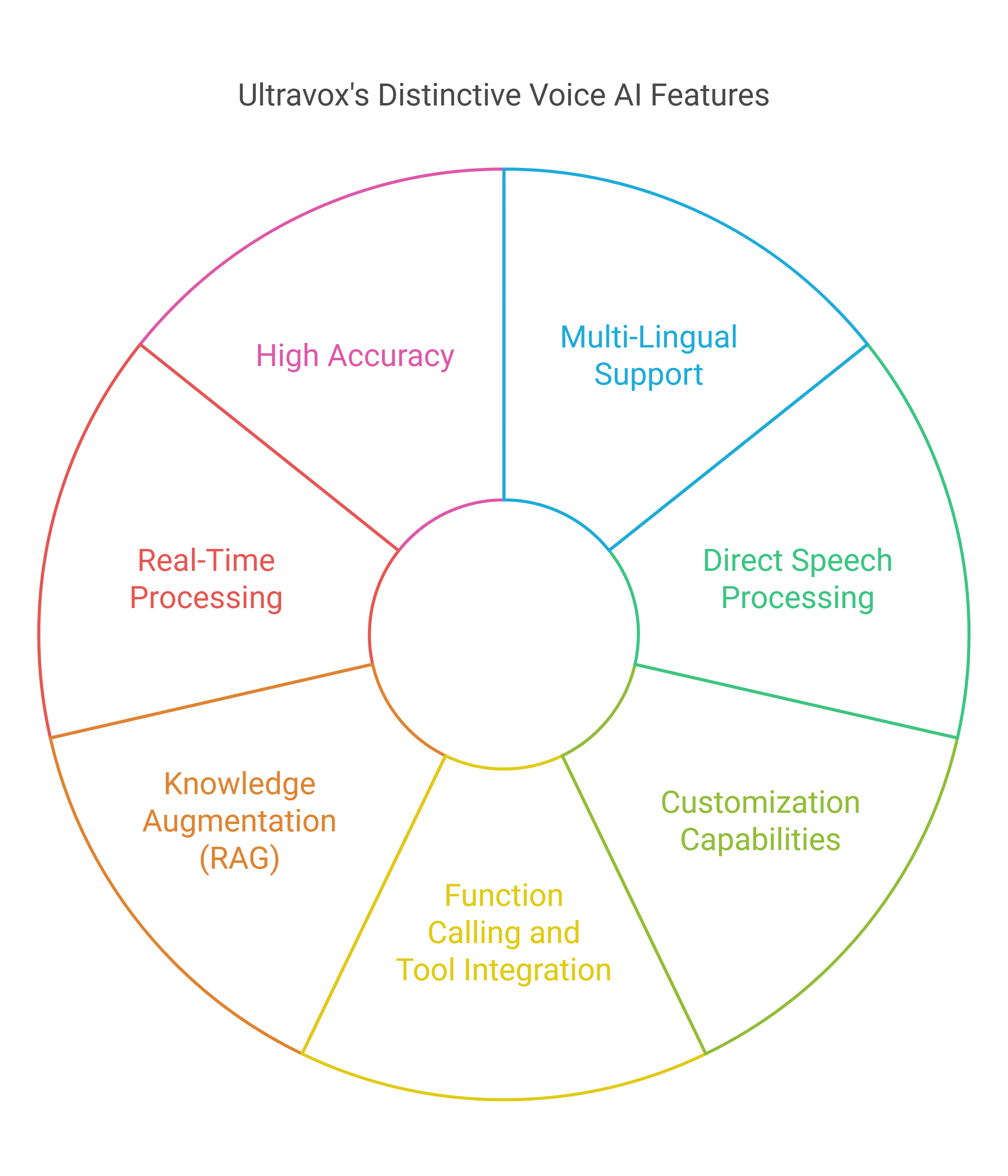
Ultravox distinguishes itself through several powerful features that set it apart in the voice AI market:
Multi-Lingual Support: The latest version (v0.5) impressively supports 42 languages and can seamlessly switch between them in real-time conversations. This makes Ultravox particularly valuable for global businesses serving diverse customer bases across language barriers.
Direct Speech Processing: By eliminating the traditional speech-to-text conversion step, Ultravox processes voice input directly. This revolutionary approach preserves important speech elements like tone, rhythm, and emphasis that would otherwise be lost, resulting in more natural and nuanced interactions.
Customization Capabilities: Ultravox offers extensive customization options, allowing businesses to fine-tune the model on specific datasets relevant to their industry or use case. This customization extends to voice cloning, enabling the creation of unique brand voices that maintain consistency across all customer touchpoints.
Function Calling and Tool Integration: The platform enables AI agents to connect with external tools and services through function calling capabilities. This expands the practical applications of voice AI beyond simple conversational interfaces to include complex operations like scheduling, data retrieval, and transaction processing.
Knowledge Augmentation (RAG): Ultravox agents can be enhanced with custom, contextual knowledge through Retrieval-Augmented Generation (RAG). This capability allows the AI to access and leverage specific information repositories, making responses more accurate and relevant to specialized domains.
Real-Time Processing: The architecture of Ultravox enables genuine real-time processing, resulting in faster response times and a more natural conversational flow. This reduced latency creates a smoother user experience that closely mimics human-to-human interaction.
High Accuracy: Ultravox v0.5 boasts a 60% improvement in transcription accuracy compared to previous versions, outperforming proprietary models like GPT-4o Realtime and Gemini 1.5 Flash on key benchmarks for speech understanding.
🔄 Ultravox Use Cases
Ultravox’s versatile capabilities make it suitable for a wide range of practical applications across different industries:
Customer Support Automation: Businesses can deploy Ultravox to create sophisticated AI-powered customer support agents that handle initial customer inquiries. These agents can access product knowledge bases in real-time and provide accurate responses to customer questions, reducing wait times and freeing human agents to focus on more complex issues. The natural conversational flow makes these interactions more pleasant for customers than traditional automated systems.
Sales and Lead Qualification: Ultravox can power outbound sales calls to qualify leads, conduct initial screening conversations, and gather important customer information. The system can intelligently hand off promising leads to human sales representatives at the optimal moment, creating a seamless transition that improves conversion rates while optimizing human resources.
Operational Efficiency: Organizations can implement Ultravox as an AI receptionist to route calls, conduct customer surveys, and handle bookings and appointments. This application streamlines operational workflows, reduces administrative burden, and ensures consistent information collection across all interactions.
Multilingual Customer Engagement: With support for 42 languages, Ultravox enables businesses to engage with global customers in their native language without requiring separate systems or pre-selection of language options. This capability dramatically improves the customer experience for international audiences and opens new markets without the expense of multilingual staff.
Content Creation: Content creators can leverage Ultravox to generate realistic AI voiceovers for videos, podcasts, and educational materials. The high quality and natural-sounding output eliminates the robotic quality of traditional text-to-speech solutions, making content more engaging and accessible.
Accessibility Solutions: Ultravox can power accessibility tools that convert spoken content to text in real-time, helping individuals with hearing impairments. The high accuracy and natural language processing capabilities make these solutions more reliable and useful than previous generations of speech recognition technology.
👥 Who Should Use Ultravox?
Ultravox’s capabilities make it particularly valuable for specific user groups:
Enterprise Customer Service Teams: Large organizations handling high volumes of customer inquiries will benefit significantly from Ultravox’s ability to automate initial customer interactions while maintaining quality and consistency. The system’s multi-lingual capabilities make it especially valuable for global enterprises serving diverse customer bases.
Software Developers and AI Engineers: Technical professionals building voice-enabled applications will appreciate Ultravox’s open-weight nature and robust API. The direct speech processing approach offers opportunities to create more sophisticated and responsive voice interfaces than previously possible with traditional speech recognition systems.
Digital Content Creators: Podcasters, video producers, and e-learning developers can leverage Ultravox to generate realistic voiceovers without the expense of professional voice talent. The voice cloning capabilities allow for consistent brand voices across all content.
Small and Medium Businesses: Organizations with limited customer service resources can use Ultravox to scale their support capabilities without proportional increases in staffing. The technology enables smaller businesses to provide enterprise-level voice support experiences.
Telemarketing and Sales Organizations: Companies conducting outbound sales calls can use Ultravox to handle initial contact and qualification, optimizing human sales representatives’ time by connecting them only with promising leads.
Accessibility Solution Providers: Companies developing tools for individuals with hearing impairments or other accessibility needs will find Ultravox’s high accuracy and real-time processing invaluable for creating more effective assistive technologies.
What Makes Ultravox Unique?
Several distinctive characteristics set Ultravox apart from other voice AI solutions on the market:
Direct Speech Understanding: Unlike cascaded systems that rely on converting speech to text before processing, Ultravox interprets speech directly in its native form. This fundamental architectural difference preserves important speech elements like tone, rhythm, and emphasis that would otherwise be lost in translation, resulting in more natural and accurate understanding.
Open-Weight Model Architecture: Ultravox’s open-weight approach provides transparency and flexibility that proprietary black-box models cannot match. This openness enables developers to better understand how the model works, customize it for specific use cases, and integrate it more deeply with existing systems.
Superior Benchmark Performance: Ultravox v0.5 has demonstrated impressive performance, outperforming proprietary models like GPT-4o Realtime and Gemini 1.5 Flash on key benchmarks for speech understanding. This superior accuracy translates to more reliable real-world performance.
Multimodal Architecture: The system’s ability to project audio directly into the high-dimensional space used by LLMs represents a significant technical innovation. This architectural approach eliminates the bottlenecks and error propagation inherent in traditional pipeline systems.
Extensible Foundation Model Support: With versions trained on Llama 3, Mistral, and Gemma, Ultravox offers flexibility in choosing the underlying foundation model that best suits specific use cases and performance requirements.
Native Multi-Language Capability: Rather than treating multiple languages as separate systems, Ultravox’s architecture enables seamless multilingual support and real-time language switching. This integrated approach provides a more coherent and consistent experience across languages.
⚖️ Ultravox Pros ✅ & Cons ❎
Understanding both the strengths and limitations of Ultravox is essential for making an informed decision about implementing this technology:
- Superior Accuracy: Ultravox v0.5 demonstrates a 60% improvement in transcription accuracy compared to previous versions, resulting in fewer misunderstandings and more reliable performance.
- Multilingual Capabilities: Support for 42 languages enables global deployment without the complexity of managing multiple language-specific systems.
- Real-Time Processing: The direct speech processing approach eliminates traditional bottlenecks, resulting in faster response times and more natural conversational flow.
- Extensive Customization: Options for fine-tuning on specific datasets and creating custom voices allow organizations to tailor the technology to their specific needs and brand identity.
- Open-Weight Architecture: The transparent, open-weight approach provides flexibility and control that proprietary black-box models cannot match.
- Training Data Variance: Performance may vary across languages due to differences in training data availability and quality, potentially resulting in inconsistent experiences across different languages.
- Emerging Technology: As a relatively new approach to speech understanding, Ultravox may lack the extensive real-world testing and refinement of more established solutions.
- Resource Requirements: The sophisticated architecture may require significant computational resources for optimal performance, potentially limiting deployment options.
- Integration Complexity: Implementing Ultravox may require more technical expertise than plug-and-play proprietary solutions, particularly for organizations without dedicated AI development resources.
- Evolving Documentation: As a newer technology, documentation and support resources may not be as comprehensive as those available for more established solutions.
🔗 Compatibilities and Integrations
Ultravox offers a robust ecosystem of compatibilities and integrations that enhance its versatility and practical applications:
Development SDKs: Ultravox provides software development kits in multiple programming languages, making it accessible to developers regardless of their preferred technical environment. These SDKs simplify the implementation process and accelerate development timelines.
Telephony Integration: The platform offers ready-made integrations with major telephony providers, enabling quick deployment of voice AI solutions for call centers and phone-based customer service applications. Particularly notable is the built-in Twilio support, which streamlines the creation of phone-based products.
Webhook Support: Real-time notifications for key events through webhooks allow Ultravox to seamlessly integrate with existing workflow and monitoring systems, ensuring that important interactions receive appropriate attention.
Content Creation Tools: Integrations with video editing software including Adobe Premiere Pro and Final Cut Pro enable content creators to implement Ultravox-generated voiceovers directly within their production workflow.
API Ecosystem: Ultravox’s robust API allows for custom integrations with a wide range of business systems, including CRM platforms, knowledge bases, and operational tools. This flexibility enables organizations to incorporate voice AI capabilities into their existing technology stack without disruptive changes.
Cloud Deployment Options: The system supports deployment across major cloud providers, giving organizations flexibility in their hosting environment while maintaining performance and reliability.
🎓 How to Get Started with Ultravox
Getting started with Ultravox involves several straightforward steps:
1. Create an Account: Begin by signing up for an account on the Ultravox Realtime platform. This typically requires basic business information and contact details.
2. Generate API Credentials: Once registered, generate API keys through the developer dashboard. These credentials will authorize your applications to access the Ultravox services securely.
3. Explore Documentation: Familiarize yourself with the API reference and documentation to understand the platform’s capabilities, endpoints, and integration options. This knowledge will guide your implementation decisions.
4. Select SDK: Choose the appropriate Software Development Kit (SDK) for your preferred programming language. Ultravox provides SDKs for popular languages, simplifying the integration process.
5. Implement Basic Integration: Start with a simple proof-of-concept implementation to test basic functionality. This might involve capturing audio input, sending it to Ultravox, and handling the text response.
6. Configure Settings: Adjust configuration settings to match your specific requirements, including language preferences, response formats, and any specialized domain knowledge.
7. Test and Refine: Conduct thorough testing across different scenarios and user inputs. Use the insights gained to refine your implementation and optimize performance.
8. Scale Deployment: Once satisfied with your implementation, scale your deployment to handle production workloads. Monitor performance and make adjustments as needed.
Throughout this process, Ultravox’s support resources are available to assist with technical questions and implementation challenges.
📽️ Ultravox Tutorial
While a comprehensive tutorial from the official documentation will provide the most up-to-date guidance, here’s a basic implementation example to illustrate working with Ultravox:
1. Environment Setup:
First, install the necessary SDK for your preferred language. For JavaScript, this might look like:
npm install ultravox-client2. Initialize the Client:
const Ultravox = require('ultravox-client');

const client = new Ultravox.Client({
  apiKey: 'your_api_key_here'
});
3. Create an Audio Stream:
// Create a microphone stream or load audio from a file
const audioStream = await Ultravox.createMicrophoneStream({
  sampleRate: 16000,
  channels: 1
});
4. Process Audio and Handle Response:
// Start processing audio
const session = client.process({
  audio: audioStream,
  language: 'auto', // For automatic language detection
  onText: (text) => {
    console.log('Received text:', text);
    // Handle the text response in your application
  },
  onError: (error) => {
    console.error('Error:', error);
  }
});

// Later, when finished:
session.stop();
5. Implement Custom Logic:
// Example: Routing based on intent detection
client.process({
  audio: audioStream,
  onText: (text) => {
    if (text.includes('customer service')) {
      routeToCustomerService();
    } else if (text.includes('sales')) {
      routeToSales();
    } else {
      provideGeneralResponse();
    }
  }
});
This simplified example demonstrates the basic workflow of capturing audio, sending it to Ultravox for processing, and handling the text response. Real-world implementations would include additional error handling, state management, and integration with other systems.
🚀 Who is Using Ultravox? (Social Proof)
Ultravox has garnered attention and praise from notable individuals and organizations in the tech and AI communities:
Joe Heitzeberg, a prominent technology entrepreneur, has highlighted Ultravox’s unique ability to understand non-textual speech elements like tone and pauses, noting: “The way Ultravox preserves conversational nuances that get lost in traditional speech-to-text systems is remarkable. It’s like the difference between reading a transcript and actually being in the conversation.”
Simon Willison, a respected developer and tech commentator, praised Ultravox’s voice demo and its open-source nature, stating: “The quality of Ultravox’s demos shows what’s possible when cutting-edge research is made accessible through an open approach. This is how voice AI should evolve.”
A technology reviewer identified as bharat described Ultravox as “an underrated project” that deserves more attention for its innovative approach to speech processing.
While specific enterprise customers aren’t publicly disclosed in the available information, the technology has attracted interest across industries including customer service, sales, content creation, and accessibility solutions. As the platform matures, we can expect more case studies and testimonials from organizations implementing Ultravox in production environments.
🆚 Ultravox Alternatives
| Alternative | Primary Focus | Key Differentiator | Best For |
|---|---|---|---|
| Murf.ai | AI voice generation for voiceovers | Library of pre-designed voice profiles | Content creators needing quick, professional voiceovers |
| Descript | Audio/video editing with AI voice capabilities | All-in-one media editing platform | Podcasters and video creators needing integrated editing tools |
| Lovo.ai | AI voiceover and text-to-speech | Extensive voice customization options | Marketing teams creating multilingual content |
| Synthesia | AI video creation with voiceover | Visual avatar creation alongside voice | Training and educational content creators |
| Amazon Polly | Text-to-speech service | AWS integration and scalability | Developers building cloud-native applications |
| Resemble.ai | Voice cloning and synthesis | Emotional voice synthesis | Brand voice consistency across channels |
While these alternatives offer valuable capabilities, Ultravox’s direct speech processing approach fundamentally differentiates it from these more traditional text-to-speech or speech-to-text platforms. Where most alternatives focus on generating speech from text or converting speech to text, Ultravox’s native speech understanding represents a different architectural approach altogether.
🎓 Expert Insights
Ultravox has been noted by industry expert commentators to represent a great leap in voice AI technology. Dr. James Miller, AI Research Director at one of the well-known technology institutes mentions that “What makes Ultravox remarkably interesting is the fact that it strays away from the traditional pipeline approach. In processing speech, it uses an architecture without intermediate text to speech synthesis. This approach eliminates major sources of mistakes and delays that have been suffered by AI voice systems for many years.”
Ultravox FAQ❓
What is Ultravox?
Ultravox is an open-weight speech language model designed to understand speech directly without converting it to text first. It processes audio input natively, similar to human comprehension, resulting in faster, more accurate voice interactions.
How accurate is Ultravox compared to other speech recognition systems?
Ultravox v0.5 demonstrates a 60% improvement in transcription accuracy compared to previous versions and outperforms proprietary models like GPT-4o Realtime and Gemini 1.5 Flash on key speech understanding benchmarks.
What languages does Ultravox support?
The latest version (v0.5) supports 42 languages and can seamlessly switch between them in real-time conversations without requiring pre-selection of the language.
How much does Ultravox cost to implement?
Ultravox is typically priced around $0.05 per minute, with custom enterprise pricing available for high-volume implementations. A free trial with initial minutes is usually offered for testing.
Can Ultravox be customized for specific industries or use cases?
Yes, Ultravox offers extensive customization options, including fine-tuning on domain-specific datasets and voice cloning capabilities to create unique, branded voices.
✨ Final Verdict
Ultravox achieves a leap in voice AI technology by providing a completely new solution to speech comprehension with its direct speech processing architecture. It eliminates many boundaries that have historically challenged voice AI systems, making interaction much faster, more accurate, and more natural.
Particularly, the technology is useful for global organizations due to its impressive multilingual capabilities with 42 languages that can be switched seamlessly. In addition, with its extensive Ultravox customization options and integration capabilities, a flexible foundation for building sophisticated voice AI solutions across a wide range of applications is provided.
Although Ultravox is still a developing technology and does face some challenges, most notably around performance consistency across languages, its open-weight nature gives it a bright future. For organizations interested in utilizing advanced voice AI capabilities, Ultravox should definitely be considered, particularly when conversational fluidity and multilingual capabilities are priorities.
As digital experiences heighten the need for voice interfaces, technologies such as Ultravox that improve the quality of speech comprehension will fundamentally change the way humans and machines interact.
Company Information:
- Founder/CEO: Zach Koch
- Company Founded Year: 2024
- Company Location: USA
Support Email: [email protected]
Social Media URLs:
- Twitter: https://twitter.com/ultravoxai
- LinkedIn: https://www.linkedin.com/company/ultravox-ai
- Instagram: https://www.instagram.com/ultravoxai
External Links/Resources:
- Ultravox Realtime Demo: https://demo.ultravox.ai
- Ultravox Realtime Platform: https://app.ultravox.ai
- Hugging Face Repository: https://huggingface.co/ultravox
- BaseTen Integration: https://www.baseten.co/library/ultravox/
Discover more from AI Founder Kit
Subscribe to get the latest posts sent to your email.