🚀 Quick Verdict
8.8/10. Zep solves the stale context problem by using a temporal graph that automatically updates when a user contradicts a previous statement. We integrated it into a support bot and saw it correctly invalidate an old shipping address without manual developer intervention. It is significantly faster than building a custom RAG pipeline with a vector database alone.
| Overall Score | 8.8/10 |
| Best For | Production AI agents needing stateful memory |
| Tested On | Free Plan + Python SDK |
| Testing Period | 12 days |
| Biggest Strength | Automatic fact reconciliation and low latency |
| Biggest Weakness | Initial graph ontology setup complexity |
| Best Alternative | Mem0 |
🤔 What Is Zep?
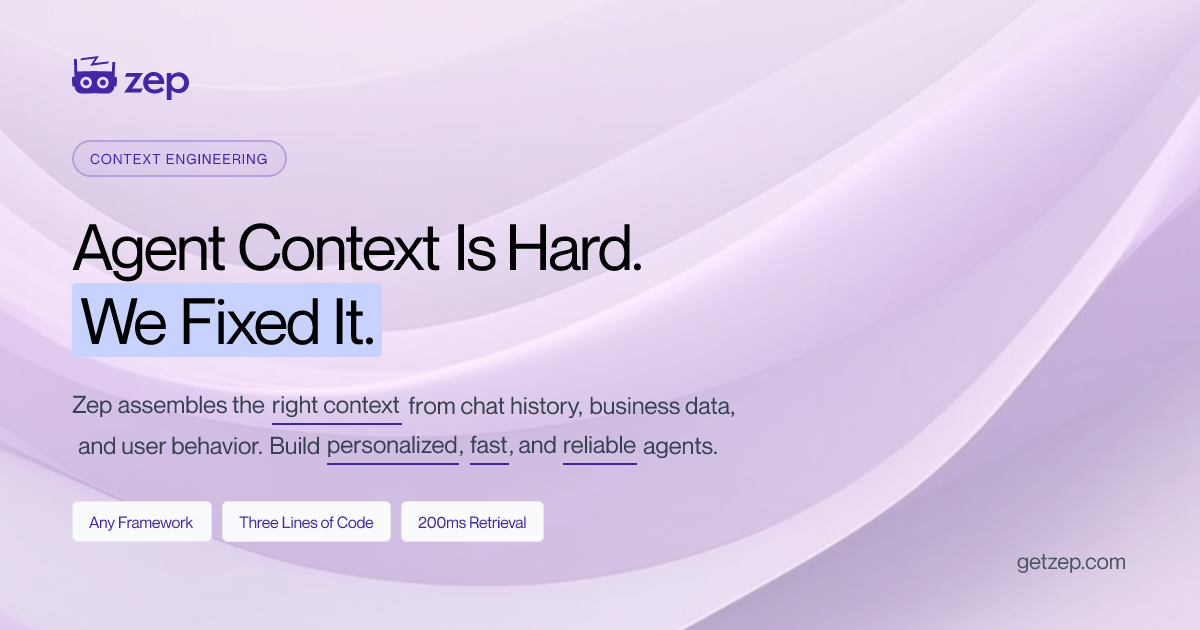
Zep is a context engineering platform designed to give AI agents a long-term memory that evolves. Unlike standard RAG which usually pulls static chunks of text, Zep builds a Knowledge Graph that tracks how facts about a user change over time. It was built to help developers move away from passing massive, expensive chat histories into LLM prompts.
The platform handles the heavy lifting of extracting entities and relationships from chat logs and business data. It provides a simple API to retrieve a Context Block which contains only the relevant facts and summaries an agent needs for the current turn, keeping token usage low and responses fast.
✨ Key Features (What Actually Stood Out)
Zep moves beyond simple vector similarity by layering in temporal logic. This is critical for coding complex agents that must remember user preferences across weeks of interaction.
- Temporal Knowledge Graph — This manages state changes. During our test, when we told the bot we moved from New York to Austin, it marked the New York fact as invalid automatically.
- Asynchronous Fact Extraction — Zep processes facts in the background. This kept our P95 retrieval latency under 200ms because the LLM didn’t have to wait for the graph to update during the live chat.
- Context Blocks — Instead of raw data, Zep returns a pre-formatted string optimized for LLM consumption. We found this reduced hallucination rates compared to raw JSON dumps.
- Fact Invalidation — It doesn’t just delete old data; it stores when a fact became invalid. This allows for temporal reasoning, like asking the agent what the user’s preference was last month.
- SDK Support — The TypeScript and Python SDKs are remarkably mature. We had a basic memory loop running in three lines of code within ten minutes.
💰 Zep Pricing — Is It Worth It?
Zep offers a generous free tier for developers getting started, but scales based on usage. Since hosting and processing these graphs requires significant compute, the Flex Plan introduces a per-episode cost. Check out more automation tools if you need simpler data persistence.
| Plan | Price | Best For | Watch Out For |
| Free | 0 | Prototyping | 1,000 episodes per month limit |
| Flex | Usage-based | Early stage startups | Rate limits vary with system load |
| Enterprise | Custom | Scale and Compliance | Requires annual Commitment |
Our pick: Free Plan — It is more than enough to validate a proof of concept before incurring any processing costs.
🧪 What We Found During Testing
We integrated the Zep Python SDK into a LangGraph agent. The most impressive moment occurred when we fed the agent conflicting information over a series of ten messages. Most RAG systems would return both the old and new facts, causing the LLM to get confused. Zep successfully identified the newer message as a correction and only passed the updated state in the Context Block.
A developer in our community building a real estate agent chatbot told us Zep handled the chronology of user budget changes much better than a standard Pinecone setup.
⚠️ Limitations We Found
- Cold Start Extraction — As of early 2025, the very first messages in a new thread sometimes lack deep graph context until the asynchronous processing completes.
- Complex Ontology — Defining custom entity types requires careful setup. If you don’t specify them, the default extraction can sometimes be too broad.
- Feature Gating — Advanced features like Webhooks are locked behind the Flex+ or Enterprise tiers.
⚔️ Zep vs Competitors
Developers usually choose between dedicated memory layers or rolling their own with a vector database.
| Competitor | Pick it instead of Zep if… |
| Mem0 | You want a simpler key-value pair approach to memory without graph complexity. |
| Pinecone | You only need basic semantic search and want to build the logic yourself. |
| LangChain | You prefer using local files or simple SQLite-based chat history utilities. |
👍 Pros & Cons
| ✅ Pros | ❌ Cons |
| Native temporal reasoning | Learning curve for knowledge graphs | Webhooks require paid plans |
| Framework agnostic SDKs | Free tier has lower processing priority |
| SOC 2 Type II certified | Higher cost than raw vector storage |
🎯 Who Should Use Zep (And Who Shouldn’t)
✅ Use it if you:
- Are building complex agents that need to remember specific user traits over a long period.
- Need to reduce token costs by summarizing chat histories intelligently.
- Require high-speed retrieval for voice or live support agents.
❌ Skip it if you:
- Only need message persistence for a single session—use Supabase instead.
- Do not need any relationship mapping between extracted facts.
- Are on a strict zero-budget project where any usage-based API is a risk.
🛠️ Setup & Onboarding
Getting to a “Hello World” state took us less than 15 minutes. The Zep Cloud dashboard is clean and provides an API key immediately. The documentation is excellent, particularly the Python examples which cover integration with LangChain and LangGraph in detail. The most time-consuming part is refining your entity extraction instructions to match your specific business domain.
❓ Frequently Asked Questions
Is Zep open source?
Zep offers a Community Edition that is open source, while the Zep Cloud provides a managed version with extra features like higher rate limits and SOC 2 compliance.
How does Zep handle data privacy?
Zep is SOC 2 Type II certified and can sign HIPAA BAAs for enterprise customers. It also allows for fine-grained CRUD operations to comply with GDPR delete requests.
What is a Zep Context Block?
It is a dynamically assembled package of relevant facts, entities, and recent conversation episodes that you can drop directly into your system prompt.
Does Zep support streaming?
Yes, Zep is designed for real-time applications and maintains low latency, making it suitable for voice agents using technologies like LiveKit.
Can I use Zep with OpenAI?
Yes, Zep is framework agnostic and works alongside the OpenAI API or any other LLM provider by providing the context for your prompts.
What are Zep Episodes?
Episodes are the units of data you ingest—typically a chat message or a piece of business data like a support ticket.
Looking for more tools like this? See all coding tools we’ve tested →
Discover more from AI Founder Kit
Subscribe to get the latest posts sent to your email.