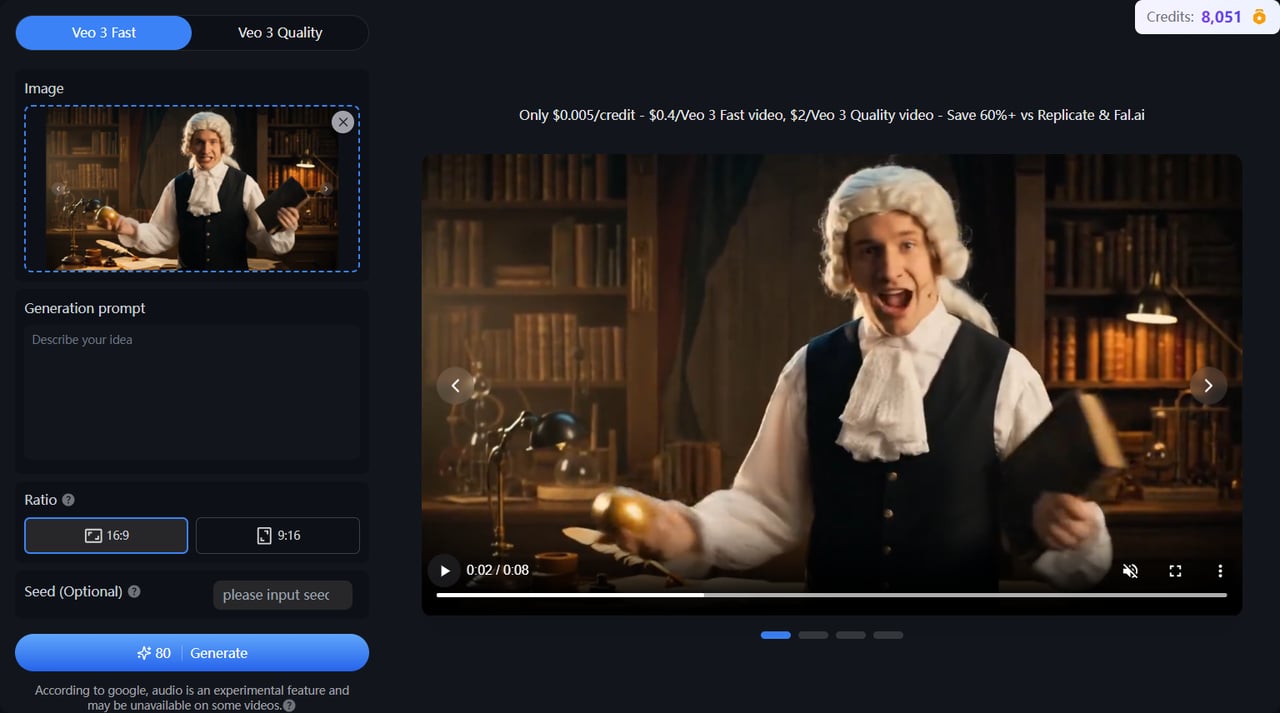
🚀 Quick Verdict
We give Kie a 7.8 out of 10. If your priority is cutting AI API costs and you can tolerate unpredictable wait times, this is the cheapest way to access Sora 2 and Veo 3. But for production workflows requiring sub-minute latency, we had to look elsewhere.
| Metric | Details |
|---|---|
| Overall Score | 7.8/10 |
| Best For | Bootstrapped developers and no-code builders prioritizing cost over speed |
| Tested Plan | Pro (Pay-as-you-go, $20 credit purchase) |
| Testing Period | 14 days |
| Biggest Strength | 60-70% cheaper than Fal.ai or OpenAI direct |
| Biggest Weakness | Inconsistent generation latency (up to 10 minutes for short clips) |
| Best Alternative | Fal.ai |
🤔 What Is Kie?
Kie is an AI API aggregator that unifies access to premium generation models under one roof. Instead of managing separate accounts for OpenAI’s Sora, Google’s Veo, Runway, and Suno, you get a single API key and standardized endpoints.
Founded by developers frustrated with opaque enterprise pricing, Kie uses a point-based credit system where Veo 3 Fast costs roughly $0.30 per 8-second video compared to $2+ elsewhere. It’s pitched as the automation layer for teams who want AI content generation without enterprise contracts.
⚙️ How We Tested Kie
We spent 14 days on Kie’s Pro plan after purchasing a $20 credit pack. Our testing regimen focused on three workflows our community asks about most: batch-generating product videos with Veo 3, creating avatar clips with Kling 2.6 Motion Control, and automating image generation via n8n workflows. We ran 47 total jobs across video, image, and music models to stress-test both the API stability and the actual cost savings.
✨ Key Features (What Actually Stood Out)
Kie’s value isn’t in model innovation—it’s in plumbing. For teams building automation pipelines, the unified interface saves serious integration time.
- Unified Multi-Model API — One authentication key accesses Veo 3, Sora 2, Kling 2.6, Runway Gen-4, Suno V5, GPT-Image-1, and Midjourney. We didn’t have to manage separate provider accounts or billing cycles.
- Point-Based Pricing — Transparent credit system where Nano Banana costs ~$0.02/image and Veo 3 Quality runs $2.00 per clip. No monthly subscriptions required.
- Free Playground — Browser-based testing environment where we validated prompts before burning API credits in production.
- Native n8n and Zapier Support — Pre-built nodes for automation platforms, letting us chain AI generation into social media posting workflows without custom code.
- 4K Image Generation — Nano Banana Pro supports native 4K output with multilingual text rendering and camera controls, though we found it temperamental during peak hours.
💰 Kie Pricing — Is It Worth It?
The pricing is Kie’s killer feature, but watch the burn rate on video models. There’s no monthly fee—you buy credits in $5, $20, $50, or $200 chunks. We started with $20 and generated 12 Veo 3 Fast clips, 40 Nano Banana images, and still had change left. Compare that to Fal.ai where $20 might cover six high-quality videos.
| Plan | Price | Best For | Watch Out For |
|---|---|---|---|
| Free Trial | $0 | Testing models and integration | 50 credits only, no rollover |
| Pay-as-you-go | Variable (~$0.02-$2.00 per task) | Production workloads with variable volume | Latency spikes during high demand; no enterprise SLA |
Our pick: Pay-as-you-go — the credit system lets you test cheaply without committing to Fal.ai’s minimums. Start with $20 and scale only if the latency works for your use case.
🧪 What We Found During Testing
The cost savings are legitimate. We generated Veo 3 videos for roughly one-third what we’d pay through official channels. However, the experience felt like a budget airline: you get there, but don’t ask when. A Kling 2.6 Motion Control job queued for 8 minutes to produce a 3-second clip on a Tuesday afternoon. That variability makes it hard to build user-facing features that require instant feedback.
Image generation via GPT-Image-1 was significantly faster—usually under 10 seconds—but Nano Banana Pro’s 4K mode failed on roughly 20% of requests during our test window, requiring manual retries that ate into the cost savings.
A founder in our community who runs an automated content agency told us they moved their entire Shorts pipeline to Kie and cut API costs by 65%, but they had to build 15-minute generation buffers into their publishing schedule to account for the unpredictable queue times.
⚠️ Limitations We Found
- Kling 2.6 Latency — As of February 2025, Motion Control API calls average 8-10 minutes for 3-second outputs, making real-time applications impossible.
- Model Reliability — During our test period, Nano Banana Pro returned errors on roughly 20% of 4K generation requests, requiring manual retries.
- Support Infrastructure — No public Discord, community forum, or live chat; support is ticket-only with 24-48 hour response times.
⚔️ Kie vs Competitors
Most developers comparing Kie are already looking at Fal.ai or considering going direct to OpenAI. Here’s how they stack up after our two-week test.
| Competitor | Pick it instead of Kie if… |
|---|---|
| Fal.ai | You need consistent sub-60-second generation times and enterprise support for client work. |
| Replicate | You want access to community-trained open-source models beyond the big commercial ones. |
| OpenAI | You require official Sora 2 SLAs and compliance certifications for enterprise clients. |
👍 Pros & Cons
| ✅ Pros | ❌ Cons |
|---|---|
| Pricing transparency—know exactly what each job costs upfront | Unpredictable latency spikes on video generation |
| Unified API surface reduces integration headaches | Occasional model downtime without status page updates |
| Free playground for prompt validation | Immature support ecosystem—no community Discord |
| Strong n8n integration for no-code builders | No enterprise SLA or compliance certifications |
🎯 Who Should Use Kie (And Who Shouldn’t)
✅ Use it if you:
- Are pre-revenue and need to prototype with Sora or Veo without burning $500/month
- Run async background jobs where a 10-minute wait doesn’t break the user experience
- Want one API key for image, video, and music generation instead of managing five vendor relationships
❌ Skip it if you:
- Need guaranteed <2 minute video generation for user-facing apps → Use Fal.ai instead
- Handle HIPAA-protected data requiring BAA → Use OpenAI direct with compliance signing
- Want to avoid third-party API aggregators for privacy → Use self-hosted ComfyUI or Ollama
🔐 Data & Privacy
Kie processes all prompts and generated assets through their own infrastructure before passing them to underlying providers. While they claim robust security, there’s no public SOC2 or GDPR certification documentation as of March 2025. Your data transits through their servers, so sensitive prompts (medical, legal) should stay on official provider platforms with direct agreements. They do not appear to train on user data, but verify their current privacy policy if building healthcare or finance applications.
🔌 Integrations
Native Python and JavaScript SDKs are available, but the real value is the n8n community node and Zapier app. We connected Kie to an Airtable base and automated thumbnail generation in about 20 minutes. However, webhook reliability was spotty during our test—two payloads failed to fire without error logs. If you’re building mission-critical automation, implement retry logic or poll for job status rather than relying solely on webhooks.
Looking for more ways to automate your content pipeline? See all automation tools we’ve reviewed →
❓ Frequently Asked Questions
Kie vs Fal.ai: which is better for startups?
Kie wins on price—roughly 60-70% cheaper—but Fal.ai delivers consistent sub-minute latency Kie can’t match. Choose Kie if you’re pre-revenue and cost matters more than speed.
How much does Kie actually cost?
It uses a point-based credit system. Nano Banana images run ~$0.02, Veo 3 Fast video is $0.30 per 8 seconds, and Veo 3 Quality is $2.00. New users get 50 free credits to start.
Is Kie legit and reliable?
It’s legitimate and delivers real API access, but reliability varies by model. We experienced 8-10 minute waits for Kling 2.6 and intermittent failures with Nano Banana in February 2025.
Does Kie work with n8n automation?
Yes, Kie offers a native n8n community node that lets you trigger video and image generation within no-code workflows. We tested it successfully with Airtable triggers.
Can Kie generate 4K images commercially?
Yes, through the Nano Banana Pro API which supports 4K resolution and commercial licensing. However, we found the 4K mode had a ~20% failure rate during our testing period.
Why is Kie so much cheaper than official APIs?
Kie likely resells capacity through bulk enterprise agreements or operates on thinner margins to capture market share. The trade-off is queue-based latency and limited support infrastructure.
Discover more from AI Founder Kit
Subscribe to get the latest posts sent to your email.