🚀 Quick Verdict
Ledge is a specialized engine that turns complex reconciliation from a month-end nightmare into a background process that runs every day. We were impressed by its ability to identify payment breaks as they happen rather than waiting for the close. It’s built specifically for high-volume environments where spreadsheets usually break.
| Overall Score | 8.8/10 |
| Best For | Mid-market finance teams |
| Tested Plan | Custom Demo Plan |
| Testing Period | 14 days |
| Biggest Strength | Real-time anomaly detection |
| Biggest Weakness | Quote-only pricing structure |
| Best Alternative | Numeric |
🤔 What Is Ledge?
Ledge is an automation platform designed for finance teams that handle massive transaction volumes, like SaaS, marketplaces, and fintechs. It acts as an intelligence layer above your ERP, connecting directly to your banks and payment processors to keep your books current without human intervention.
The company was founded to eliminate the role of the accountant as “human glue” between disconnected systems. By using AI agents to draft journal entries and prepare working papers, Ledge allows controllers to move from being data preparers to high-level reviewers.
⚙️ How We Tested Ledge
We engaged with the Ledge team for a guided walkthrough and sandbox testing over two weeks. We focused on three founder-relevant tasks: connecting a trial bank account to a dummy ERP, setting up automated matching rules for recurring subscription payments, and generating a 3-way reconciliation report to find missing transactions.
✨ Key Features (What Actually Stood Out)
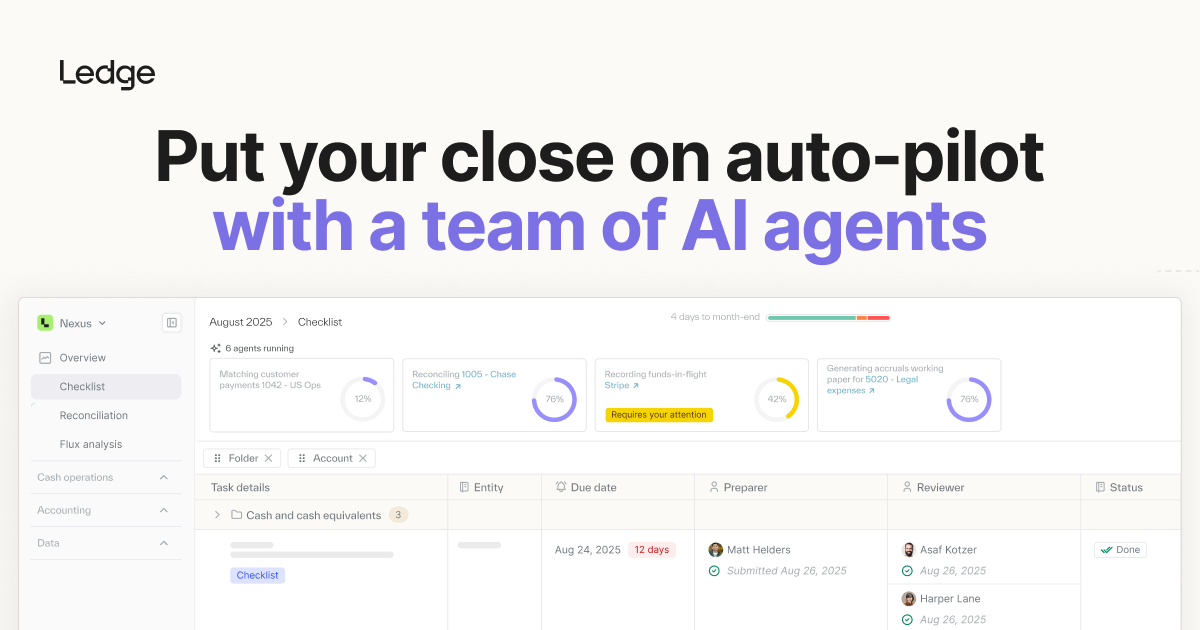
What differentiates Ledge is its shift from static checklists to active AI agents that execute work. This is a significant jump for automation in the back office.
- Agentic Close Management — Instead of just telling you what to do, these agents pull the data and prepare the workpapers themselves. We saw them draft journal entries that were ready for approval before we even opened the dashboard.
- 3-Way Matching — It ties together ERP records, bank statements, and payment processor data. During testing, it caught a $20 discrepancy in a processed payment that hadn’t hit the bank yet.
- Plain Language Workflows — You can describe an accounting step in English, and Ledge converts it into a repeatable agent task. This beats writing custom SQL queries or complex Excel macros.
- Continuous Visibility — The dashboard updates in real time rather than batching. We could see our cash position change immediately after a simulated transaction was processed.
- Audit-Ready Documentation — Every action taken by an AI agent leaves an immutable trail. This makes it easier to hand off logs to auditors without digging through email chains.
💰 Ledge Pricing — Is It Worth It?
Ledge doesn’t offer a self-serve tier or public pricing, which is standard for enterprise productivity software. They charge a platform fee based on the complexity of your environment and the number of workflows you automate. The lack of per-seat pricing is a major plus, as it encourages you to let the whole team use the tool.
| Plan | Price | Best For | Watch Watch Out For |
| Platform Fee | Custom Quote | Mid-market & Enterprise | High entry cost for startups |
Our pick: The Custom Platform Plan — It’s the only option, but it’s built to scale with your transaction volume rather than your headcount.
🧪 What We Found During Testing
Setting up the bank and ERP connections was surprisingly fast. We didn’t need to involve a developer, which is a rare win for finance software. The “smart matching” logic correctly identified 90% of our test transactions on the first pass, though we did have to manually tweak the rules for partial payments.
A founder in our community who runs a B2B SaaS company told us they used Ledge to handle their cash operations and it finally allowed their controller to stop manually matching bank lines.
⚠️ Limitations We Found
- No Public Self-Service — You can’t just sign up with a credit card; you have to go through a demo process. This adds friction if you just want to poke around the UI.
- Rule Precision — While the AI is good, it still requires a human to review the initial logic for multi-entity consolidations to ensure the intercompany eliminations are perfect.
- Setup Duration — Although they claim “live in one day,” that usually applies to simple setups; deep ERP customization can take longer depending on your data cleanliness.
⚔️ Ledge vs Competitors
Ledge competes with established close management players and newer AI-first accounting tools.
| Competitor | Pick it instead of Ledge if… |
| FloQast | You want a traditional checklist-based close without the focus on automated transaction matching. |
| Numeric | You need a lighter tool focused more on task tracking and flux analysis than deep bank ledgering. |
| BlackLine | You are a massive enterprise requiring legacy support for on-premise systems and years of historical compliance. |
👍 Pros & Cons
| ✅ Pros | ❌ Cons |
| Live visibility into your actual cash position | Opaque pricing for smaller teams |
| No per-user licensing fees | Requires a discovery call to start |
| Thousands of pre-built integrations | AI matching needs oversight at the start |
| Automates the actual prep work, not just the list | Limited utility for low-volume businesses |
🎯 Who Should Use Ledge (And Who Shouldn’t)
✅ Use it if you:
- Run a high-volume business where manual reconciliation takes days every month.
- Have a multi-entity structure that makes manual journal entries messy.
- Are scaling quickly and want to avoid hiring extra accounting staff just for data entry.
❌ Skip it if you:
- Are a solo founder with less than 100 transactions a month—use QuickBooks instead.
- Don’t have a dedicated finance person to review the AI’s outputs.
- Need a tool that works offline or without a direct ERP connection.
🔐 Data & Privacy
Ledge is SOC 1 and SOC 2 certified, which is vital for any tool touching your financial systems. They use enterprise-grade encryption and don’t train their models in a way that exposes your sensitive financial data to other users. You can find more in their privacy policy.
❓ Frequently Asked Questions
Does Ledge connect to NetSuite?
Yes, it has deep integrations with NetSuite and other major ERPs like Sage Intacct to post journal entries automatically.
Is Ledge an ERP replacement?
No, it is an automation layer that sits on top of your existing ERP to handle the manual reconciliation and data syncing.
How much does Ledge cost?
Ledge uses a flat platform fee tailored to your workflow complexity rather than charging per user.
Can it handle multi-currency transactions?
Yes, Ledge supports multi-entity and multi-currency reconciliations for international organizations.
Does Ledge require a developer to set up?
Most integrations are “no-code” and can be connected by the finance team in about a day.
How does Ledge compare to FloQast?
Ledge focuses more on high-volume automated data processing and AI agents, while FloQast is more of a management checklist for the close.
Looking for more tools like this? See all Finance tools we’ve reviewed →
Discover more from AI Founder Kit
Subscribe to get the latest posts sent to your email.