Mercury Banking for Startups
In today’s fast-paced digital economy, startups and tech companies require banking solutions that match their innovative spirit and operational needs. Mercury has emerged as a groundbreaking financial platform that’s fundamentally changing how modern businesses handle their banking needs. This comprehensive review will explore Mercury’s offerings, diving deep into its features, pricing structure, and whether it might be the right choice for your business.
Quick Take: Mercury Banking represents the future of business banking, combining the security of traditional banking with the innovation of modern fintech. Its zero-fee structure, powerful API capabilities, and startup-focused features make it an exceptional choice for tech-savvy businesses seeking a comprehensive banking solution.
The banking landscape has evolved dramatically in recent years, with traditional banks struggling to keep pace with the unique needs of modern businesses. Mercury steps into this gap with a purpose-built solution that understands and addresses the specific challenges faced by startups and tech companies. From managing investor funds to tracking burn rates and enabling seamless integrations, Mercury has positioned itself as more than just a bank – it’s a comprehensive financial operating platform.
The Mercury Story: More Than Just Another Banking Platform
Mercury Banking journey began in 2019 when founders Immad Akhund, Max Tagher, and Jason Zhang recognized a crucial gap in the financial services industry. Traditional banks weren’t equipped to handle the unique needs of modern startups, while existing fintech solutions lacked the comprehensive feature set required by growing businesses. Operating from their headquarters in San Francisco, Mercury partnered with FDIC-insured banks to create a solution that combines the security of traditional banking with the innovation of modern technology.
The platform has grown significantly since its inception, serving thousands of businesses and processing billions in transactions annually. What sets Mercury apart is its deep understanding of the startup ecosystem, reflected in every feature and service they offer. Unlike traditional banks that have merely digitized their existing services, Mercury built its platform from the ground up with modern businesses in mind.
Mercury Pricing
Mercury’s pricing philosophy centers around transparency and value, with a tiered structure designed to grow with your business:
Standard Plan – The Foundation of Digital Banking
The Standard plan comes with zero monthly fees and no minimum balance requirements, making it accessible to businesses of all sizes. This tier includes all essential banking features such as:
Free checking and savings accounts that earn competitive interest rates, enabling businesses to maximize their idle cash. Users receive both physical and virtual debit cards, offering flexibility in managing expenses. The plan includes basic API access, perfect for businesses beginning to automate their financial operations. Standard users can process ACH payments and wires, though international wire fees apply.
Tea Room – Premium Banking for Growing Businesses
The Tea Room tier, while still maintaining a zero-fee structure, requires a minimum deposit of $250,000. This tier unlocks premium features designed for scaling businesses, including:
Exclusive debit card designs that reflect your business’s professional status. Advanced API access with higher rate limits and additional endpoints for more sophisticated integrations. Free international wire transfers, saving significant costs for businesses operating globally. Enhanced support options with faster response times and more personalized assistance.
Scale – Enterprise-Grade Solutions
The Scale tier offers customized solutions for larger businesses with complex needs. Pricing is custom-tailored to each business’s specific requirements and includes:
Personalized feature sets based on your business’s unique needs. Dedicated support teams ensuring immediate assistance when needed. Enterprise-grade security features with advanced fraud protection. Custom integration solutions and API capabilities.
| Plan | Monthly Fee | Features |
|---|---|---|
| Standard | $35 | • Free checking and savings accounts • Physical and virtual debit cards • Basic API access • ACH payments and wires |
| Tea Room | $135 (Min. $250,000 deposit) | • All Standard features • Premium debit card designs • Advanced API access • Free international wires |
| Scale | Custom | • All Tea Room features • Customized solutions • Dedicated support • Enterprise-grade security |
Mercury Banking Features
Mercury’s feature set extends far beyond basic banking services, creating a comprehensive financial ecosystem for modern businesses:
Digital Banking Excellence
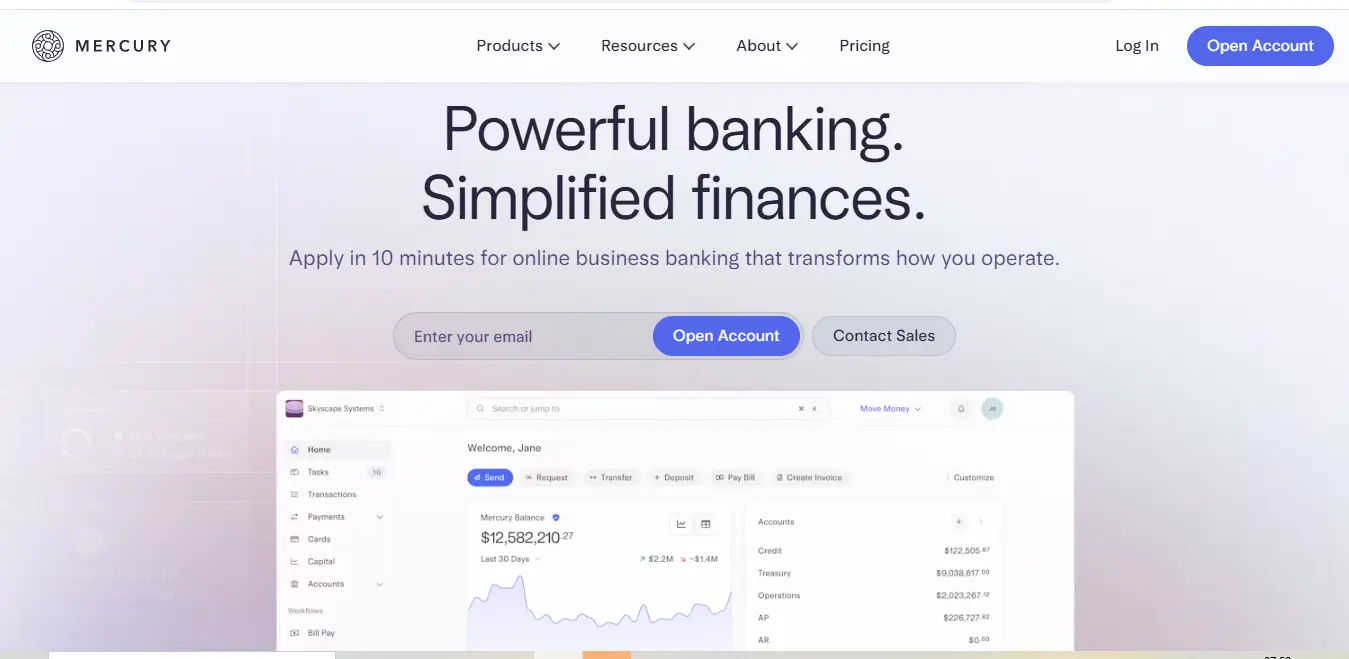
At its core, Mercury Banking offers robust digital banking services through FDIC-insured partner banks. The platform provides multiple checking and savings accounts, allowing businesses to organize their finances efficiently. Each account comes with both physical and virtual debit cards, offering flexibility in managing expenses. The web and mobile interfaces are intuitive and user-friendly, providing real-time access to your financial information from anywhere.
Advanced Financial Management
Mercury’s financial tools set it apart from traditional banks. Real-time transaction monitoring provides instant visibility into your business’s financial health. The platform offers sophisticated team management features with role-based access controls, ensuring secure delegation of financial responsibilities. The API access enables deep integration with your existing business tools, automating financial workflows and reducing manual tasks.
Treasury Management and Investment
Through Mercury Treasury, businesses can optimize their idle cash with high-yield savings options and investment opportunities. The platform provides treasury management tools typically reserved for larger corporations, making them accessible to startups and growing businesses. Cash flow optimization features help businesses make the most of their available funds while maintaining necessary liquidity.
Mercury Banking Real-World
Mercury’s versatility shines through in its various use cases across different business types:
Startup Financial Operations
For startups, Mercury serves as a comprehensive financial command center. The platform excels at managing investor funds, providing clear visibility into burn rates, and maintaining separate accounts for different purposes. Features like API access and automated reporting make it easier to keep investors informed and manage runway effectively.
E-commerce Business Solutions
E-commerce businesses benefit from Mercury’s robust payment processing capabilities and seamless integration with popular platforms. The ability to manage multiple payment streams, automate reconciliation, and handle international transactions makes it an ideal solution for online retailers. Real-time transaction monitoring helps track sales performance and manage cash flow effectively.
Tech Company Integration
Software companies find particular value in Mercury’s developer-friendly features. The comprehensive API access allows for deep integration with existing systems, while automated workflows reduce manual financial tasks. The platform’s modern interface and team management features align perfectly with how tech companies operate.
.svg)
The Ideal Mercury User Profile
Mercury Banking services are particularly valuable for specific business types and operational styles:
Early-Stage Startups
For early-stage startups, Mercury provides an ideal combination of basic banking needs and growth-oriented features. The zero-fee structure preserves capital, while the platform’s scaling capabilities support rapid growth. Startups particularly appreciate the modern interface and automated tools that reduce administrative overhead.
Fast-Growing Tech Companies
Technology companies that prioritize automation and integration capabilities find Mercury’s API-first approach invaluable. The platform’s ability to handle complex financial operations while maintaining simplicity in day-to-day use makes it perfect for tech-focused teams.
International Businesses
Companies doing business in the US market benefit from Mercury Banking understanding of international business needs. The platform simplifies US banking access while providing features that support global operations, such as international wire transfers and multi-currency capabilities.
Mercury ⚖️ Pros & Cons
- No monthly fees or minimum balances
- Powerful API access
- Modern, intuitive interface
- Excellent integration capabilities
- High-yield savings options
- No cash deposits
- Limited physical presence
- Some features restricted to higher tiers
- No personal banking options
Mercury’s Unique Value Proposition
What truly sets Mercury Banking apart in the crowded fintech space is its comprehensive understanding of modern business needs:
Technology-First Philosophy
Unlike traditional banks that have retrofitted digital features onto legacy systems, Mercury built its platform from the ground up with modern businesses in mind. This approach results in seamless integrations, powerful API capabilities, and an intuitive user experience that reflects current business practices.
Startup Ecosystem Integration
Mercury’s deep understanding of the startup ecosystem is evident in its feature set. From tools designed to manage investor relations to burn rate monitoring and runway analysis, every aspect of the platform supports the unique needs of growing companies.
Transparent Banking Model
The commitment to zero fees and transparent pricing sets Mercury apart from both traditional banks and many fintech competitors. This approach aligns with modern businesses’ expectations for clarity and fairness in financial services.
Integration Capabilities and Technical Ecosystem
Mercury Banking approach to integrations reflects a deep understanding of modern business operations. The platform serves as a central hub in a broader financial technology ecosystem, offering seamless connections with essential business tools and services. This integration capability extends across various categories of business software and services.
In the accounting sphere, Mercury offers deep integration with popular platforms like QuickBooks, Xero, and FreshBooks. These integrations go beyond simple data synchronization – they enable automated reconciliation, real-time transaction matching, and sophisticated financial reporting. For instance, when a payment is processed through Mercury, the transaction data automatically flows into your accounting software, complete with all relevant details and categorizations.
The platform’s developer tools showcase its technical sophistication. Integration with Stripe enables seamless payment processing and reconciliation, while Plaid integration facilitates secure connections with other financial services. The Zapier integration extends Mercury’s automation capabilities, allowing businesses to create custom workflows that connect their banking activities with hundreds of other applications.
For team collaboration, Mercury’s Slack integration proves particularly valuable. Teams can receive real-time notifications about important transactions, account updates, and potential issues directly in their Slack channels, ensuring everyone stays informed without constantly monitoring the banking platform.
Getting Started with Mercury: A Comprehensive Guide
The process of setting up a Mercury Banking account has been thoughtfully designed to balance security requirements with user convenience. The journey begins at Mercury’s website, where businesses can initiate the sign-up process through a streamlined application form. While the process is straightforward, it requires careful attention to detail and proper documentation.
Initial documentation requirements include basic business information such as your EIN (Employer Identification Number), articles of incorporation, and ownership details. Mercury takes security seriously, conducting thorough identity verification for all account signers. This process, while comprehensive, typically moves quickly for businesses with complete documentation.
Once approved, account activation involves several key steps. Users must first set up their security preferences, including two-factor authentication and team access controls. Mercury provides a detailed onboarding checklist that guides new users through essential account features and settings. This includes setting up payment methods, configuring notification preferences, and establishing initial account parameters.
Mastering Mercury: A Practical Tutorial
Understanding Mercury Banking features and capabilities requires a systematic approach. The platform’s functionality can be broken down into several key operational areas that businesses typically engage with daily. Let’s explore these areas in detail to help users maximize their use of the platform.
Account management in Mercury begins with understanding the dashboard’s organization. The main interface provides immediate access to account balances, recent transactions, and pending actions. Users can create multiple sub-accounts for different purposes – for example, separating operating expenses from payroll or maintaining dedicated accounts for specific projects or departments.
Transaction management forms the core of daily operations. Mercury provides various ways to process payments, from simple ACH transfers to international wire transfers. The platform’s search and filtering capabilities make it easy to track specific transactions, while the tagging system helps organize expenses for better financial tracking.
Team management features allow businesses to grant appropriate access levels to different team members. Administrators can set specific permissions for various functions, from view-only access to full transaction capabilities. This granular control ensures security while maintaining operational efficiency.
Mercury’s Impact: Real-World Success Stories
Mercury Banking effectiveness is best illustrated through the experiences of its users. The platform has garnered significant adoption among notable startups and tech companies, each demonstrating different aspects of Mercury’s capabilities.
Linear, a rapidly growing project management tool company, utilizes Mercury to manage its complex financial operations. Their team particularly values the platform’s API capabilities, which allow them to automate many financial processes and integrate banking data directly into their internal systems.
Retool, a successful development platform, chose Mercury for its ability to handle rapid scaling. As the company grew from a small startup to a significant player in the development tools space, Mercury’s flexible banking solutions adapted to their changing needs, from managing increasing transaction volumes to handling more complex financial operations.
Pipe, a revenue trading platform, represents another success story. Their use of Mercury’s treasury management features and international banking capabilities has supported their global expansion while maintaining efficient financial operations.
Comparing Mercury with Alternative Banking Solutions
The business banking landscape offers several alternatives to Mercury Banking, each with its own strengths and focus areas. Brex, a prominent competitor, emphasizes rewards and expense management, making it particularly attractive to companies with significant employee spending. Their reward structure offers points on various business expenses, though their banking services may not be as comprehensive as Mercury’s.
Silicon Valley Bank (SVB) represents a more traditional banking approach, offering extensive experience with startup banking and venture capital relationships. While they provide comprehensive banking services, their digital capabilities and user interface may not match Mercury’s modern approach.
Rho focuses on mid-sized businesses, offering a combination of banking services and spend management tools. Their platform provides good expense tracking and approval workflows, but may not offer the same level of API access and developer tools as Mercury.
Novo targets small businesses with a digital-first approach similar to Mercury’s. While they offer a solid suite of business tools and integrations, their platform may not scale as effectively for rapidly growing companies or those requiring sophisticated treasury management features.
| Platform | Best For | Pricing | Key Difference |
|---|---|---|---|
| Brex | Larger startups | Free | Emphasis on rewards |
| SVB | Established companies | Varies | Traditional banking |
| Rho | Mid-sized businesses | Free | Spend management |
| Novo | Small businesses | Free | Business toolkit |
Expert Perspectives on Mercury’s Platform
Industry experts have provided valuable insights into Mercury Banking position in the financial technology landscape. Sarah Chen, a prominent fintech analyst, notes that “Mercury has successfully transformed the traditional banking model by creating a platform that truly understands and addresses the needs of modern businesses. Their approach to combining banking services with technology tools sets a new standard for business banking.”
Michael Roberts, a respected tech reviewer, emphasizes Mercury’s technical capabilities: “What sets Mercury apart is their API-first approach. They’ve built a platform that not only handles banking tasks efficiently but also integrates seamlessly with the modern business technology stack. This makes it particularly valuable for tech-savvy companies that prioritize automation and integration.”
Banking industry veteran James Mitchell points out Mercury’s impact on the startup ecosystem: “Mercury has filled a crucial gap in the market by providing banking services that actually align with how modern startups operate. Their understanding of startup financial needs, from managing investor funds to tracking burn rates, makes them a natural choice for new companies.”
Final Verdict
Mercury Banking stands out as an excellent banking solution for modern businesses, particularly startups and tech companies. Its combination of zero-fee banking, powerful API access, and startup-focused features makes it a compelling choice for businesses seeking a digital-first Mercury Banking experience.
Mercury FAQs❓
What can Mercury do?
Mercury provides digital banking services, including checking and savings accounts, debit cards, API access, and financial management tools designed specifically for startups and tech companies.
Is Mercury Free?
Yes, Mercury’s Standard tier is completely free with no monthly fees or minimum balance requirements. Premium features are available in higher tiers.
Is Mercury FDIC insured?
Yes, Mercury partners with FDIC-insured banks to provide banking services, ensuring deposits are protected up to $250,000.
Can international companies use Mercury?
Yes, Mercury supports international companies doing business in the US, though they must have a US corporate entity.
How does Mercury make money?
Mercury Banking generates revenue through interchange fees, premium account fees, and treasury services.
What are Mercury’s security features?
Mercury Banking offers enterprise-grade security, including two-factor authentication, role-based access control, and advanced fraud protection.
Important Links:
- Twitter: https://www.x.com/mercury
- LinkedIn: https://www.linkedin.com/company/mercuryhq
- Instagram: https://www.instagram.com/mercuryfi/
- Support Email: [email protected]
External Resources:
- Mercury Blog: https://mercury.com/blog
- Mercury API Documentation: https://mercury.com/developers
- Mercury Community Forum: https://community.mercury.com
Company Information:
- Founders: Immad Akhund (CEO), Max Tagher, Jason Zhang
- Founded: 2019
- Location: San Francisco, California
Discover more from AI Founder Kit
Subscribe to get the latest posts sent to your email.