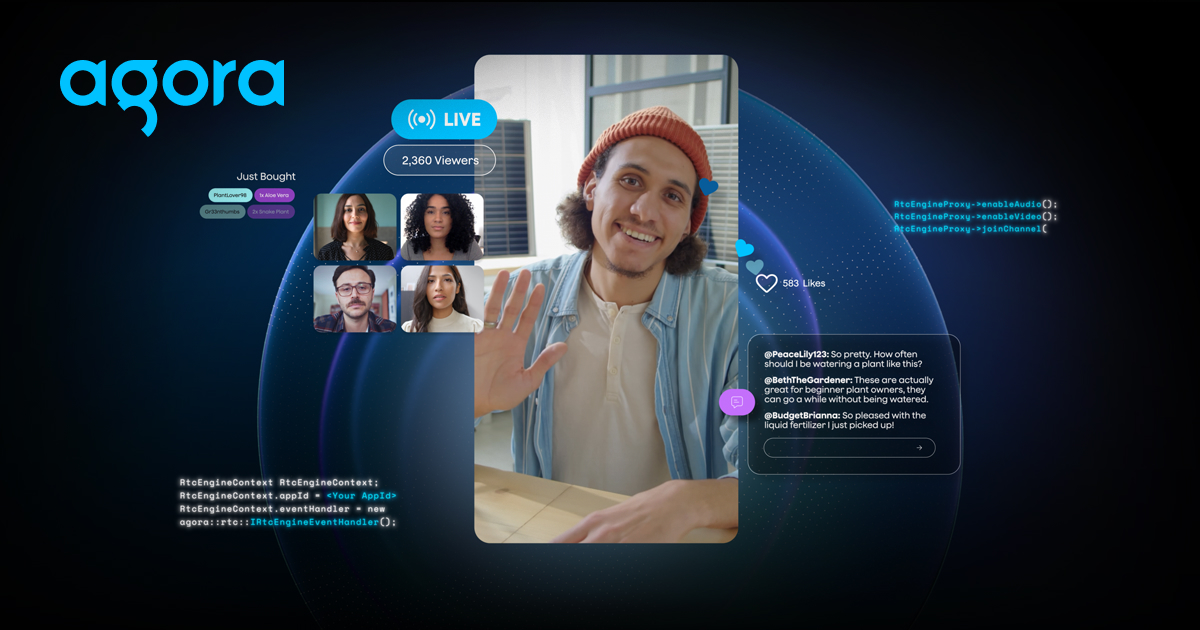
Quick Verdict 🚀
Agora is an excellent tool for developers and enterprises seeking to embed real-time voice, video, and interactive live streaming into their applications. As the industry standard for Real-Time Engagement (RTE), Agora provides a robust, scalable infrastructure that handles the complexities of global network routing, allowing businesses to focus on user experience rather than server maintenance. With the recent addition of advanced Conversational AI capabilities, Agora has future-proofed its platform, making it not just a communication tool but a comprehensive solution for the next generation of agentic AI interactions.
| Quick Overview | Rating / Info |
|---|---|
| Overall Score | 9.5/10 |
| Best For | Developers, Startups, Enterprises building apps with RTC |
| Starting Price | Free / $0.004 per min (paid) |
| Biggest Strength | Ultra-low latency & global SD-RTN™ network |
| Main Weakness | Complexity for absolute non-developers |
| Best Alternative | Twilio Video / Vonage |
What is Agora? 🤔
Agora is a Real-Time Engagement (RTE) platform-as-a-service (PaaS) that provides application programming interfaces (APIs) and software development kits (SDKs) for developers to add real-time voice, video, and broadcasting functionalities to their applications. Whether you are building a telehealth app, an online classroom, a gaming lobby, or a live shopping platform, Agora delivers the underlying infrastructure to ensure crystal-clear audio and high-definition video with minimal latency.
Created by Tony Zhao in 2014, Agora was born out of the vision to make real-time interaction accessible and ubiquitous. The company stands out for its proprietary Software-Defined Real-Time Network (SD-RTN™), a virtual network structure optimized for real-time transmission that covers over 200 countries and regions. This global network automatically selects the best route for data packets, ensuring quality and stability even in fluctuating network conditions. Today, Agora powers over 80 billion minutes of communication monthly and is trusted by leading organizations like Talkspace, HTC, and KUMU.
In 2025, Agora has evolved beyond simple peer-to-peer communication. It now integrates deeply with Conversational AI, offering tools like the Conversational AI Engine and Real-Time Transcription. This allows developers to build AI agents that can see, hear, and speak to users in real-time, bridging the gap between human-to-human and human-to-machine interaction. By leveraging this comprehensive ecosystem, businesses can create immersive, social, and interactive experiences that were previously only possible for tech giants with massive engineering resources.
Key Features 🔑
- Conversational AI Engine – Build voice AI agents with any LLM, featuring interruption handling, VAD (Voice Activity Detection), and ultra-low latency streaming for natural dialogue.
- Ultra-Low Latency Video SDK – Delivers HD video with less than 300ms latency globally, featuring adaptive video optimization (AVO) for smooth performance on low-bandwidth networks.
- Interactive Live Streaming – Enables one-to-many broadcasts with low latency, supporting features like PK battles, co-hosting, and real-time audience interaction for social and gaming apps.
- Real-Time Transcription & Translation – Converts speech to text instantly during calls and supports multi-language translation, essential for global meetings and accessibility.
- AI Noise Suppression – Uses advanced machine learning to filter out background noise (barking dogs, construction, keyboard typing) while preserving the clarity of the human voice.
Beyond these core features, Agora offers a robust Analytics dashboard that provides deep insights into call quality, network issues, and user behavior. This data is crucial for developers to proactively troubleshoot problems and optimize the user experience. Furthermore, the Extensions Marketplace allows for plug-and-play integrations with third-party services, enhancing functionality without writing extra code. For those looking to build without extensive coding, the App Builder offers a no-code/low-code solution to get a real-time app up and running in minutes.
Agora Pricing & Best Plan 💰
Agora utilizes a consumption-based pricing model, meaning you generally pay for the minutes of usage (audio or video) processed through their network. However, they offer one of the most generous free tiers in the industry, making it accessible for hobbyists and startups to prototype their ideas without immediate financial commitment. As you scale, the cost per minute decreases, offering significant value for high-volume applications.
| Plan | Price | Best For | Key Limits |
|---|---|---|---|
| Free | $0 | Testing & MVPs | 10,000 free mins/month (aggregate) |
| PAYG (Pay-as-you-go) | From $0.004/min | Startups & Growth | Billed based on usage volume |
| Packages | Custom / Prepaid | Best value for stability | Volume discounts & committed minutes |
| Enterprise | Custom Quote | Large Teams & Companies | Dedicated support, SLA, custom infra |
The Best Plan: For most new developers, the Free Plan is the perfect entry point. You receive 10,000 monthly minutes, which is sufficient to launch a beta version of an app. Once you exceed this limit, the Pay-As-You-Go model kicks in. Pricing varies by region (e.g., US, Europe, India, China) and by function (Audio vs. Video). Video is generally more expensive than audio. For established businesses with predictable traffic, purchasing Packages (prepaid bundles) is often the most cost-effective route, lowering the effective per-minute rate compared to standard PAYG.
Real-World Use Cases & Results 🌍
We analyzed Agora’s performance across several high-demand professional scenarios. Here is how the platform holds up when subjected to real-world stress tests and diverse application requirements.
| Use Case | Performance Metric | Quality | Recommendation |
|---|---|---|---|
| Telehealth Consultations | ≈ 99.99% Uptime | Excellent (HIPAA Ready) | Strongly recommended |
| Live Shopping Events | ≈ 400ms Latency | Great (Interactive) | Strongly recommended |
| Gaming Voice Chat | ≈ 200ms Latency | Excellent | Strongly recommended |
| Virtual Classrooms | High Concurrency | Good (Depends on network) | Strongly recommended |
In Telehealth, reliability and privacy are non-negotiable. Agora’s compliance with HIPAA, SOC2, and GDPR makes it a top choice. Doctors report that the video clarity is sufficient for preliminary examinations, and the stability is rarely an issue. In Live Shopping, the interaction between the host and the audience drives sales. Agora’s low latency ensures that when a viewer asks a question via audio or text, the host can respond instantly, creating a cohesive “in-store” feel. This real-time connection is vital for engagement, as seen with clients like LiSA achieving conversion rates of up to 35%. For Gaming, voice chat needs to be flawless and low-latency. Agora’s 3D Spatial Audio feature adds an immersive layer, allowing players to hear where sounds are coming from in a 3D space, significantly enhancing the gameplay experience.
Agora vs Main Competitors ⚔️
While Agora is a market leader, the Real-Time Communication (RTC) space is populated with robust alternatives. The primary competitors include Twilio, Vonage (formerly Nexmo), and specialized platforms like 100ms or Daily.co. Twilio is the biggest competitor, offering a similar set of programmable voice and video APIs. However, developers often find that Agora outperforms in pure connection quality and latency, particularly in challenging network environments. Vonage offers strong APIs but is sometimes viewed as having a more complex interface and less aggressive performance optimization for emerging markets.
| Tool | Quality | Speed | Price | Winner & Why |
|---|---|---|---|---|
| Agora | 10/10 | 10/10 | 8/10 | — |
| Twilio | 8/10 | 8/10 | 7/10 | Documentation & Ecosystem |
| Vonage | 8/10 | 8/10 | 7/10 | Unified Communications |
| 100ms | 9/10 | 9/10 | 9/10 | Best for Video-First products |
Twilio is often the “default” choice for developers already using its SMS or Voice APIs, providing a unified ecosystem. However, when video quality is the priority, Agora’s SD-RTN™ generally provides a superior experience with less jitter and packet loss. 100ms is a strong contender specifically for live video streaming; they have built a very developer-friendly interface specifically for the “video-first” era, often winning on ease of use for specific streaming use cases, though Agora still holds the edge in global network reach and AI capabilities.
Pros and Cons 👍👎
Before committing to Agora for your application development, it is crucial to weigh the advantages against the potential limitations. While Agora offers a premium service, it may not be the perfect fit for every single project.
| ✅ Pros | ❌ Cons |
|---|---|
| Unmatched Latency: The proprietary SD-RTN™ ensures <300ms latency globally, making it the fastest option for interactive apps. | Complexity: While APIs are clean, mastering the platform and handling signaling requires solid dev knowledge. |
| AI Integration: Native support for Conversational AI and Noise Suppression sets it apart from basic WebRTC providers. | Cost at Scale: While the free tier is great, high-volume enterprise usage can get expensive compared to self-hosted solutions. |
| Global Reliability: Optimized for diverse network conditions, ensuring good quality even on 3G or unstable 4G networks. | Support Tiers: Priority support and SLA guarantees are reserved for higher-tier enterprise plans. |
| Flexibility: Works across iOS, Android, Web, Flutter, Unity, and more, allowing for consistent cross-platform functionality. | Documentation Depth: While extensive, some advanced edge-case troubleshooting can require deeper community digging. |
Final Verdict & Who Should Buy It 🏆
Agora earns 9.5/10 overall. It is the undisputed champion for developers prioritizing quality, latency, and scalability. The platform’s evolution into the AI space further solidifies its position as a forward-thinking leader for the next decade of application development. If your app’s success depends on the fluidity of interaction—like a telehealth diagnosis or a split-second gaming decision—Agora is the infrastructure you want backing you.
- You should use Agora if you are building a Telehealth, Social Live, or EdTech app requiring HD video/voice.
- You should use Agora if you need to integrate Conversational AI agents with low latency.
- You should use Agora if you have a global user base requiring consistent performance across different network qualities.
- If you need basic SMS/Voice notifications → try Twilio instead.
- If you are building a simple hobby project and need zero code → try StreamYard instead.
- If you want to self-host to avoid vendor lock-in → try Jitsi or Mediasoup instead.
Frequently Asked Questions ❓
Is Agora better than Twilio?
For video and real-time engagement quality, Yes. Agora generally offers lower latency and better video optimization, especially in developing markets. Twilio is better if you need a broad suite of communication tools (SMS, Email, Voice) in one place.
How much does Agora cost?
Agora starts with a free tier of 10,000 minutes per month. After that, it operates on a pay-as-you-go model starting around $0.004 per minute for audio, with video costing slightly more depending on resolution.
Does Agora use your data for training?
Agora generally adheres to strict enterprise privacy standards. You should review the specific data processing addendum, but unlike some AI consumer apps, Agora focuses on transport rather than content mining.
Is Agora beginner-friendly?
For absolute non-coders, No. While they offer an “App Builder” that requires no code, fully customizing the SDKs requires knowledge of JavaScript, Swift, Kotlin, or other programming languages.
What is currently the strongest alternative?
Twilio is the strongest all-around competitor due to its brand recognition and massive ecosystem, though 100ms is gaining traction specifically for video streaming communities.
Discover more from AI Founder Kit
Subscribe to get the latest posts sent to your email.