🚀 Quick Verdict
We were surprised by how little effort it took to swap providers. By changing just one line of code, we routed requests meant for OpenAI to Claude without rewriting our integration logic. It’s a massive relief for founders who worry about single-provider outages.
| Overall Score | 9.2/10 |
| Best For | Founders building multi-model apps |
| Tested Plan | Free Tier ($0) |
| Testing Period | 7 days |
| Biggest Strength | One-line provider switching |
| Biggest Weakness | Limited deep app instrumentation |
| Best Alternative | Langfuse |
🤔 What Is Helicone AI Gateway?
Helicone is an open-source platform that sits between your application and your AI providers. It acts as a smart router that logs every request, tracks your spending, and handles errors automatically. If OpenAI goes down, Helicone can automatically switch your traffic to another provider like Anthropic.
The tool was built for developers who need reliability and clear visibility into their token usage. It supports over 100 models through a single interface. Since it’s built in Rust, it handles high traffic volumes without slowing down your app responses.
⚙️ How We Tested Helicone AI Gateway
We used the Free tier for 7 days to run three specific founder tasks. First, we routed a request to Claude 3.5 Sonnet using the standard OpenAI SDK. Second, we set up an automatic fallback so that if a GPT-4o request timed out, it would immediately retry using Gemini. Third, we reviewed the cost-per-user logs to see exactly which test users were the most expensive.
✨ Key Features (What Actually Stood Out)
The platform makes it easy to move beyond a single model setup. You can explore more coding tools to see how they fit into your build process.
- Unified API — You use the OpenAI SDK for everything. We switched from GPT-4 to Mistral just by changing the model name in our code.
- Automatic Failover — We simulated a provider outage and Helicone redirected the traffic to a secondary model. This keeps your app running even when a major provider has a bad day.
- Semantic Caching — If a user asks the same question twice, Helicone serves the cached response. This saved us money on tokens and reduced wait times for the user.
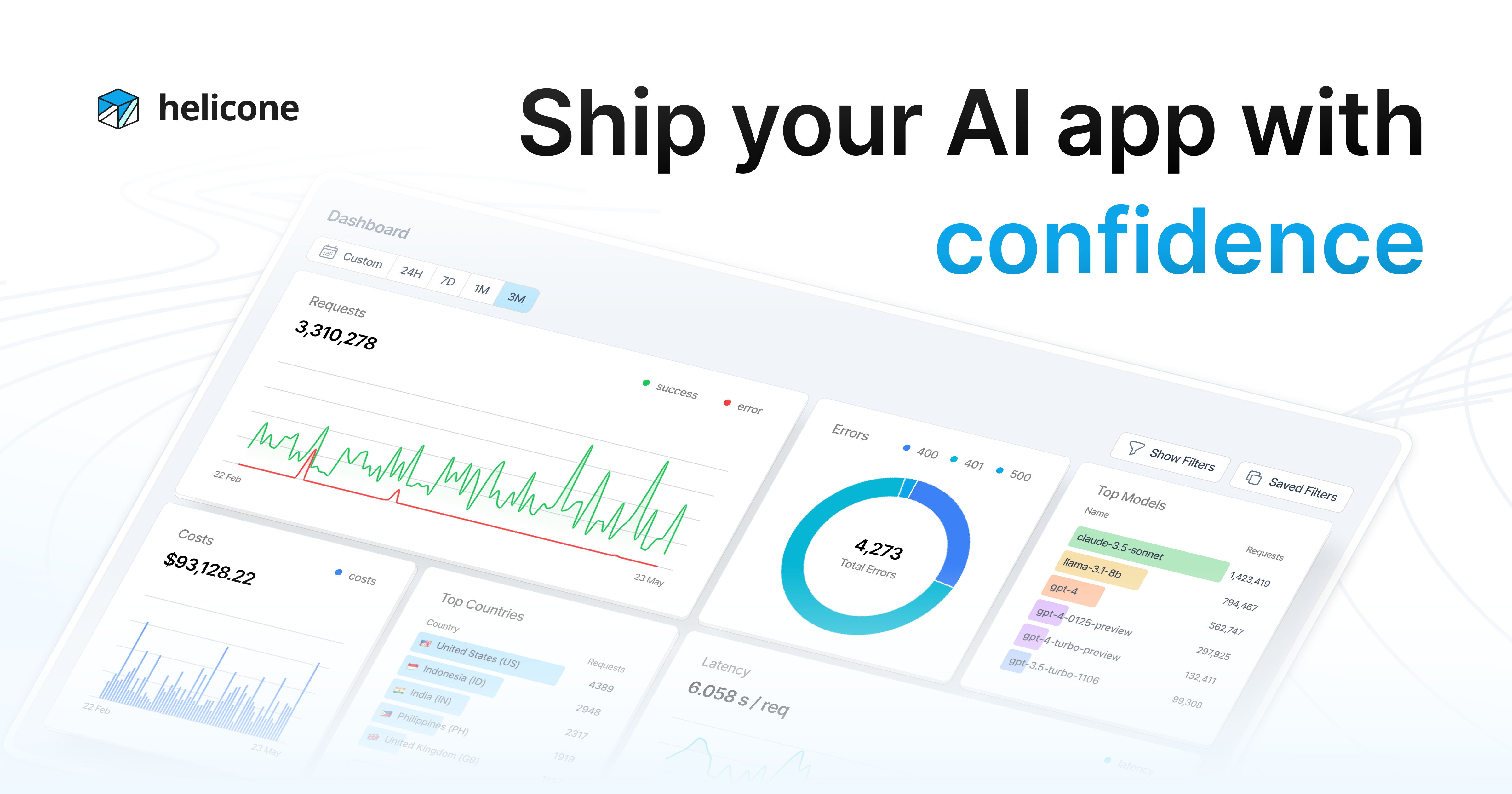
- Cost Tracking — The dashboard shows exactly what you’re spending across different providers. It breaks down costs by model and user ID so you can spot expensive patterns.
- Prompt Management — You can edit prompts in the Helicone UI without redeploying your code. We updated a system prompt and saw the change go live instantly.
💰 Helicone AI Gateway Pricing — Is It Worth It?
Helicone uses a freemium model with zero markup on the tokens you use. You’re paying the provider’s direct price plus a small processing fee if you use their unified billing. It’s a great fit for teams that want to automate their automation workflows across different AI models.
| Plan | Price | Best For | Watch Out For |
| Free | $0 | Small projects | Limited monthly requests |
| Pro | Usage-based | Scaling startups | Higher volume costs |
Our pick: Free — It’s more than enough for founders in the early stages of building an AI product.
🧪 What We Found During Testing
Setting up was as fast as they claimed. We just changed the base URL in our environment variables and the logs started appearing in the dashboard immediately. The latency was unnoticeable during our tests, which was a concern since it’s an extra hop for the data.
A founder in our community who runs a content agency told us they switched their base URL to Helicone and immediately saw which clients were burning through the most tokens.
⚠️ Limitations We Found
- Instrumentation Depth — As of late 2025, Helicone focuses on the request level. It doesn’t trace what happens inside your application logic as deeply as some specialized observability tools.
- Self-hosting Friction — We noticed that setting up the open-source version on your own servers requires significant technical knowledge. The cloud version is much easier for founders.
- Gateway Latency — While minimal, adding any proxy adds a few milliseconds to every request. This might matter for high-frequency real-time applications.
⚔️ Helicone AI Gateway vs Competitors
Most people compare Helicone to tools that focus more on deep debugging or simple proxying.
| Competitor | Pick it instead of Helicone AI Gateway if… |
| LangSmith | You need deep, nested traces of complex agent workflows. |
| Langfuse | You want a more visual way to evaluate prompt quality. |
| LiteLLM | You prefer a Python-based library for local model management. |
👍 Pros & Cons
| ✅ Pros | ❌ Cons |
| Switches models without code changes | Extra hop adds slight latency | Dashboard can feel busy |
| Excellent cost-per-user tracking | Self-hosting is technically difficult |
| Built-in caching saves money | Limited internal app tracing |
🎯 Who Should Use Helicone AI Gateway (And Who Shouldn’t)
✅ Use it if you:
- Are a founder who wants to avoid being locked into one AI provider.
- Need to see exactly which users are costing you the most money.
- Want to update your AI prompts without waiting for a developer to push code.
❌ Skip it if you:
- Only use one model and don’t care about tracking costs.
- Need deep instrumentation of complex multi-step agents, in which case check out LangSmith.
- Have zero technical comfort with changing an API base URL.
❓ Frequently Asked Questions
Does Helicone add a markup to OpenAI prices?
No, Helicone uses zero markup pricing. You pay the same rates as you would directly with the provider, plus standard payment processing fees if you use their unified bill.
How many models can I access through the gateway?
Helicone supports over 100 models from providers like OpenAI, Anthropic, Google, and Mistral through a single API key.
Will using a gateway slow down my AI app?
Helicone is built in Rust for high performance. While it adds a tiny amount of network latency, the difference is usually unnoticeable for standard chat or text generation apps.
Can I use my own API keys with Helicone?
Yes, you can bring your own keys (BYOK) for observability-only mode or use their unified billing system to simplify your accounting.
What happens if a provider like OpenAI goes down?
Helicone has an automatic failover feature. You can configure it to switch to a different model or provider immediately if the primary one fails.
Is Helicone open source?
Yes, the platform is open source. You can use their cloud version or host it yourself on your own infrastructure if you have the technical resources.
Looking for more tools like this? See all coding tools we’ve reviewed →
Discover more from AI Founder Kit
Subscribe to get the latest posts sent to your email.