🚀 What is Retool Internal Tools?
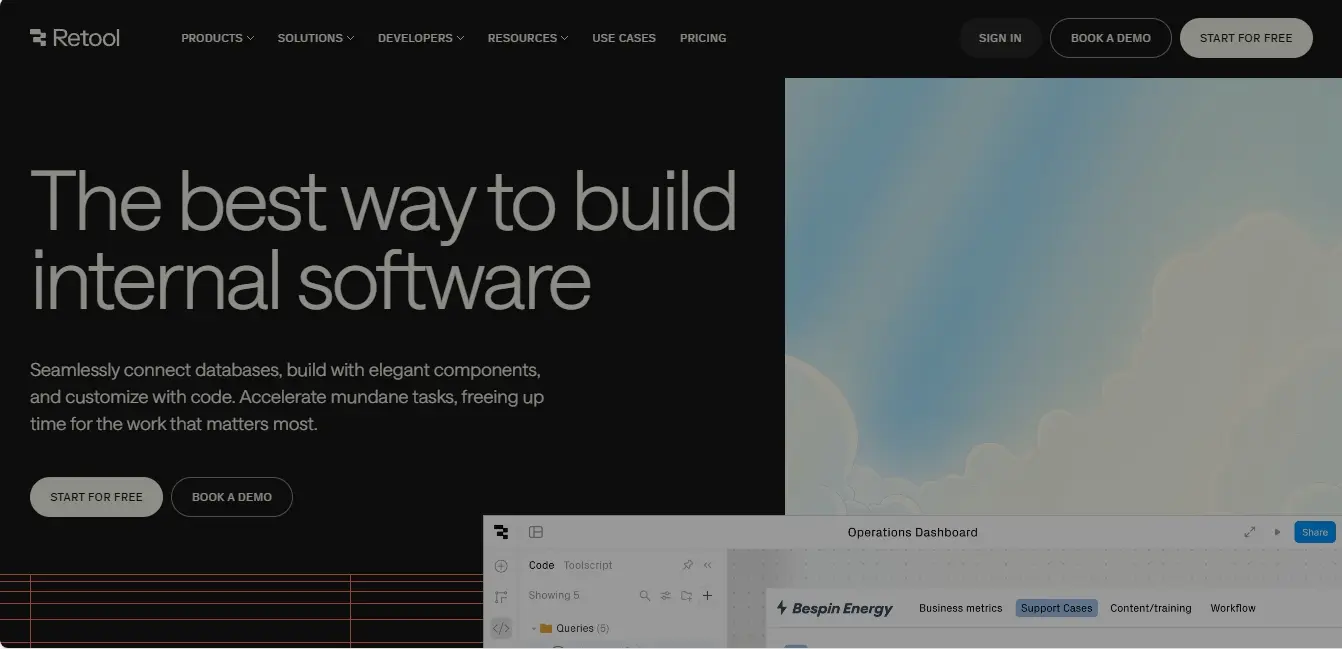
Retool Internal Tools is the trustworthy internal tool-building platform for all internal development changes. Essentially, Retool also allows developers to code internally required applications in a much lesser time rather than developing everything from scratch using c++. Retool’s platform serves to connect data sources and user interfaces. Such that, they would have no need to worry about the frontend when building admin panels to sophisticated operational tools.
🎯 Key Features Of Retool Internal Tools:
1. User-Friendly Visual Interface
Retool is built on an advanced drag and drop builder which stands out from basic no-code tools. The visual interface of Retool provides developers with the flexibility they need without requiring them to repeat work on the UI. Designers have the freedom to interact with components both visually and with the source code.
2. Very Comprehensive Data Sources Connection
Next, Retool Internal Tools data integration capabilities are more than simply connection interfaces. Tools within the platform allow for operations that involve real time queries, changing raw data and operating data from different sources at the same time. Imbedding custom SQL queries, paving API calls, and attaching in-built data application techniques to the platform are within the scope of the developers.
3. Implementing Custom Codes
As a low-code platform, Retool allows custom code whenever needed. Developers can program JavaScript to handle intricate company logic, design custom hooks that allow for functions to be reused, and create unique authentication schemes. This combination of strategies lets you be able to use more than the visual aspects of the platform during development.
4. Ready Made Templates in the Library
The platform includes over 100 production-ready components that include simple elements of a form and sophisticated tools for data visualization. Each element is customizable and provides professional uses that save hundreds of hours of front through development models.
5. Version Control and Collaboration
Built-in version control allows teams to track changes, roll back when needed, and maintain multiple environments. The collaboration features include real-time editing, commenting, and role-based access control, making team development seamless.
6. Security Framework
Enterprise-grade security features include SSO integration, audit logs, and granular permission controls. Retool can be deployed on-premises or in the cloud, with full control over data access and security protocols.
7. API Integration Framework
The platform excels at API integration, supporting REST, GraphQL, and custom protocols. Built-in authentication handling and request management make working with multiple APIs straightforward and secure.
8. Automated Testing
Retool includes tools for automated testing of your applications, allowing teams to ensure reliability and catch issues before deployment. The testing framework supports both unit tests and end-to-end testing scenarios.
9. Mobile Responsiveness
While primarily focused on desktop applications, Retool provides robust support for mobile-responsive design. Components automatically adapt to different screen sizes, and custom mobile layouts can be implemented when needed.
10. AI Integration Capabilities
Recent additions to Retool include AI integration features, allowing teams to incorporate machine learning models and AI services directly into their applications. This includes text generation, image processing, and custom model integration.
⚡ What Does Retool Internal Tools Do Well?
Retool excels in several key areas that make it particularly valuable for internal tool development:
Rapid Development
The platform significantly reduces development time by eliminating the need to build common components from scratch. What might take weeks with traditional development can often be accomplished in days or even hours with Retool.
Data Flexibility
Retool Internal Tools approach to data integration is both powerful and flexible. The platform handles complex data operations gracefully, whether you’re working with databases, APIs, or file systems. Real-time data updates and caching are handled automatically, reducing the complexity of building data-intensive applications.
Enterprise Scalability
Unlike many low-code platforms, Retool is built to scale with enterprise needs. The platform handles increased load gracefully, supports complex authentication scenarios, and provides the audit trails and security features that large organizations require.
🎯 Real World Use Cases
Customer Support Dashboards
Support teams use Retool to build comprehensive customer management systems that combine data from multiple sources. For example, a support dashboard might integrate Zendesk tickets, Stripe payment information, and internal user data to provide a complete view of customer interactions.
Operations Management Tools
Operations teams build workflow management tools that automate complex processes. One common use case is order management systems that combine inventory data, shipping provider APIs, and customer information to streamline fulfillment processes.
Financial Reporting Systems
Finance teams create sophisticated reporting tools that pull data from various sources, perform complex calculations, and generate customized reports. These tools often include real-time data visualization and export capabilities.
Content Management Systems
Media companies build custom CMS tools that handle complex content workflows, including asset management, approval processes, and publishing pipelines. These systems often integrate with existing content platforms while adding custom functionality specific to the organization’s needs.
🚀 How to Get Started With Retool Internal Tools:
Getting started with Retool follows a straightforward process:
- Initial Setup
Begin by signing up for a free account at retool.com. The platform offers a generous free tier that’s perfect for exploring its capabilities. During setup, you’ll choose between cloud hosting and self-hosted options. - Data Connection
Connect your first data source using Retool’s guided setup process. The platform supports most common databases and APIs out of the box, with clear documentation for each integration type. - Building Your First App
Start with one of Retool’s templates or build from scratch. The visual editor makes it easy to lay out your application, and the extensive documentation helps you understand each component’s capabilities. - Testing and Deployment
Use Retool’s built-in testing tools to verify your application’s functionality. Once ready, deploy your app with a single click, making it immediately available to your team.
👥 Who Is Retool Internal Tools For?
Retool is intended for a certain role within the organization that acts as an interface between the development and operational business units. The platform mainly addresses the needs of technical teams that have to provide rapid development of internal tools with reasonable management over their code and infrastructure.
The Re-tool is appealing to software developers as it streamlines the process of developing UI controls and provides for custom coding if necessary therefore they are not fully dependent on UI components. This duality appeals to developers as it is often the case that a merge of both approaches is the best solution.
Retool Internal Tools also provides strong data integration capabilities needed by data scientists and data analysts. Now data professionals may design advanced business visualization and self-service dashboards without getting into complex details of front end development. This platform is also good for data applications because of its built-in SQL editor and data transformation capabilities.
Retool is also used by product managers or technical leads to test and build internal tools in a short time. The visual development environment of the platform allows for quick changes in the designs and functionalities of the tools without the need for excessive engineering work.
What the Re-tool internal tools do seam worth it are the ability to derive workflows and build tools that fit into existing setups in operations teams.
🏢 Who is Using Retool Internal Tools?
Retool Internal Tools has gained significant traction across various industries and company sizes. Here are some notable organizations and their use cases:
Amazon uses Retool to build internal dashboards for monitoring and managing various operational aspects of their business. Their teams leverage the platform’s ability to handle large data sets and complex workflows.
DoorDash has implemented Retool for creating customer support and operations management tools. The platform helps them manage their vast network of drivers, restaurants, and customers efficiently.
Stripe utilizes Retool for internal financial monitoring and reporting tools. The platform’s ability to handle sensitive data securely while providing powerful visualization capabilities makes it ideal for fintech applications.
Brex has built various internal tools using Retool to manage their credit card operations and customer service workflows. The platform’s flexibility allows them to create custom solutions that match their unique business processes.
🌟 What Makes Retool Internal Tools Unique?
Retool Internal Tools distinguishes itself through several key differentiators:
Developer-First Philosophy
Unlike many low-code platforms that prioritize simplicity over functionality, Retool maintains a developer-first approach. This means providing full access to code when needed while still offering the benefits of visual development.
Enterprise-Grade Security
The platform’s security features go beyond basic authentication. Retool offers granular permissions, audit logging, and compliance features that make it suitable for even highly regulated industries.
Extensive Integration Capabilities
Retool Internal Tools ability to connect with virtually any data source or API sets it apart. The platform handles complex authentication scenarios and provides powerful tools for data transformation and manipulation.
🔄 Compatibilities and Integrations
Retool Internal Tools integration ecosystem is extensive and continuously growing:
Databases
- PostgreSQL
- MySQL
- MongoDB
- Amazon Redshift
- Microsoft SQL Server
- Oracle
- Snowflake
Cloud Services
- Amazon Web Services (AWS)
- Google Cloud Platform
- Microsoft Azure
- Digital Ocean
APIs and Services
- REST APIs
- GraphQL
- gRPC
- Stripe
- Salesforce
- Twilio
- SendGrid
Authentication
- OAuth 2.0
- SAML
- OpenID Connect
- Custom Auth
.png)
💰 Pricing Table Structure
| Feature | Free | Team | Business | Enterprise |
|---|---|---|---|---|
| Price (per user/month) | $0 | $10 | $50 | Custom |
| Users | Up to 5 | Unlimited | Unlimited | Unlimited |
| Apps | 3 | Unlimited | Unlimited | Unlimited |
| Database Connections | 1 | Unlimited | Unlimited | Unlimited |
| Custom Branding | ❌ | ✅ | ✅ | ✅ |
| SSO | ❌ | ❌ | ✅ | ✅ |
| Audit Logs | ❌ | Basic | Advanced | Complete |
| Support | Community | Priority | Dedicated | |
| SLA | None | 99.9% | 99.95% | Custom |
🔄 Alternative Comparison
| Feature | Retool | Bubble | Internal | Mendix |
|---|---|---|---|---|
| Primary Focus | Internal Tools | Web Apps | Internal Tools | Enterprise Apps |
| Code Flexibility | High | Medium | Medium | High |
| Learning Curve | Moderate | Steep | Moderate | Steep |
| Enterprise Features | Extensive | Limited | Good | Extensive |
| Pricing (Starting) | Free | $25/mo | $20/mo | Custom |
| Database Support | Extensive | Limited | Good | Extensive |
| Mobile Support | Limited | Good | Limited | Extensive |
✅ Pros & Cons
1. Rapid Development and Deployment
Retool Internal Tools most significant strength lies in its ability to drastically reduce development time. Traditional internal tool development often takes weeks or months but Retool enables teams to build complex applications in days or even hours. This acceleration comes from:
- Pre-built components that eliminate the need for frontend development from scratch
- Drag-and-drop interface that speeds up UI construction
- Ready-to-use database and API connections
- Template library for common use cases
Real Impact: One engineering team reported reducing their internal tool development time by 80%, from 3 weeks to 3 days for a complex customer support dashboard.
2. Technical Flexibility and Customization
Unlike many low-code platforms that restrict developers, Retool provides extensive flexibility:
- Full access to write custom JavaScript and SQL
- Ability to create custom components when needed
- Freedom to implement complex business logic
- Direct database query capabilities
- Custom API integration options
Real Impact: Teams can maintain their existing coding practices while leveraging the platform’s visual tools, creating a perfect balance between speed and control.
3. Robust Integration Capabilities
The platform excels at connecting various data sources and services:
- Support for multiple database types (SQL, NoSQL)
- Native integration with popular services (Stripe, Salesforce)
- Custom API support with authentication handling
- Real-time data synchronization
- Multiple authentication methods
Real Impact: Organizations can build tools that unite data from disparate sources without building complex integration layers.
4. Enterprise-Grade Security
Security features that make Retool suitable for large organizations:
- SSO integration with major providers
- Role-based access control (RBAC)
- Audit logging for all actions
- Data encryption at rest and in transit
- Compliance with major security standards
1. Steep Learning Curve
Despite its visual interface, Retool presents several challenges for new users:
- Requires understanding of JavaScript and SQL
- Complex component configuration options
- Need to learn Retool-specific concepts
- Limited resources for beginners
- Overwhelming number of features initially
Real Impact: Teams often need dedicated training time, typically 2-4 weeks, before becoming fully productive with the platform.
2. Cost Considerations
The pricing structure can become expensive:
- Per-user pricing model scales linearly with team size
- Higher tiers needed for essential enterprise features
- Additional costs for self-hosting
- Premium support costs
- Resource usage limitations on lower tiers
Real Impact: A medium-sized team of 50 users could face monthly costs exceeding $2,500 on the Business plan, making it a significant investment.
3. Limited Mobile Development Capabilities
Mobile app development remains a weak point:
- No native mobile app development support
- Limited responsive design options
- Mobile preview limitations
- Performance issues on complex mobile layouts
- Lack of mobile-specific components
Real Impact: Organizations needing robust mobile applications often need to seek additional solutions alongside Retool.
4. Performance Limitations
Some performance challenges can arise:
- Slower loading times with large datasets
- Resource-intensive with multiple integrations
- Browser memory limitations
- Query optimization challenges
- Cache management complexity
Real Impact: Applications handling large data sets may require careful optimization and architecture planning.
5. Version Control and Collaboration Challenges
While version control exists, it has limitations:
- Basic branching capabilities
- Limited conflict resolution tools
- No local development environment
- Challenging team collaboration on single apps
- Deployment pipeline restrictions
Real Impact: Large teams working on complex applications may face workflow bottlenecks.
6. Documentation and Support Gaps
Support infrastructure has room for improvement:
- Inconsistent documentation quality
- Limited community resources
- Variable response times for support
- Complex troubleshooting processes
- Sparse advanced feature documentation
⚠️ Why Retool Internal Tools May Not Be The Best Choice:
Despite its strengths, Retool may not be the ideal solution in certain scenarios:
For Non-Technical Teams
Organizations without technical expertise may struggle to utilize Retool effectively. The platform assumes a certain level of technical knowledge and may be overwhelming for purely business users.
For Customer-Facing Applications
Retool Internal Tools is specifically designed for internal tools. Organizations primarily needing to build customer-facing applications should consider alternatives like Bubble or traditional development frameworks.
For Small Teams with Limited Budgets
The pricing structure may be prohibitive for small teams or startups with limited resources. The cost per user can add up quickly as teams grow.
👨💼 Expert Opinion Of Retool Internal Tools:
According to Sarah Chen, CTO at TechScale Solutions: “Retool Internal Tools has fundamentally changed how we approach internal tool development. The platform’s combination of visual development and code flexibility allows our teams to build sophisticated applications in a fraction of the time it would take with traditional development. However, it’s important to note that success with Retool Internal Tools requires technical expertise and a clear understanding of your requirements.”
📝 Summary Of Retool Internal Tools:
Retool Internal Tools stands as a powerful platform for building internal tools, offering a unique combination of visual development and code flexibility. Its extensive integration capabilities, robust security features, and developer-first approach make it particularly valuable for technical teams needing to create sophisticated internal applications quickly.
The platform excels in rapid development and data integration but may not be the best choice for non-technical teams or customer-facing applications. Its pricing structure and learning curve should be carefully considered when evaluating the platform for your organization.
Retool FAQs❓
How long does it take to learn Retool?
For developers familiar with JavaScript and SQL, the basic concepts can be grasped within a few days. However, mastering the platform’s advanced features typically takes several weeks of hands-on experience.
Can Retool handle sensitive data securely?
Yes, Retool Internal Tools offers enterprise-grade security features including SSO, audit logging, and role-based access control. The platform can be deployed on-premises for maximum security control.
Does Retool support mobile development?
While Retool Internal Tools applications can be made mobile-responsive, the platform is primarily designed for desktop applications. Native mobile app development is not currently a core feature.
Can I migrate existing applications to Retool?
Yes, but the process requires careful planning. Retool provides migration tools and documentation, but applications often need to be rebuilt to take advantage of the platform’s features.
What programming languages does Retool support?
Retool Internal Tools primarily uses JavaScript for custom code and SQL for database queries. The platform also supports various query languages for different databases.
How does Retool handle version control?
Retool includes built-in version control features, allowing teams to track changes, maintain multiple environments, and roll back when needed.
🌐 Social Media & Support
- Twitter: https://x.com/retool
- LinkedIn: https://www.linkedin.com/company/tryretool
- Support Email: [email protected]
🔗 External Resources
- Official Documentation: https://docs.retool.com
- Retool Community Forum: https://community.retool.com
- GitHub Repository: https://github.com/tryretool
- YouTube Tutorial Channel: https://youtube.com/retool
- Retool Blog: https://retool.com/blog
- API Documentation: https://retool.com/docs/api
Discover more from AI Founder Kit
Subscribe to get the latest posts sent to your email.